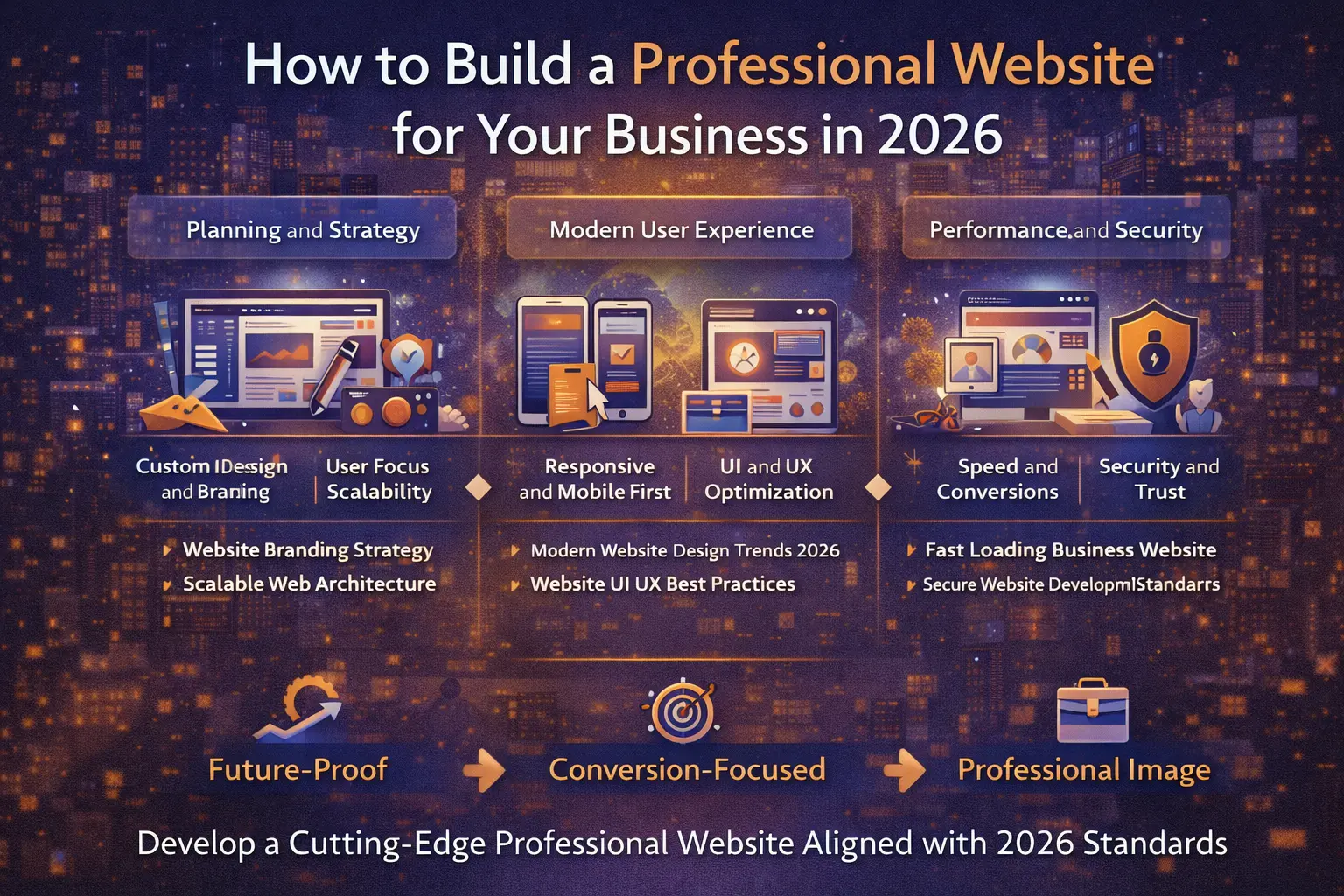
Let’s be brutally honest for a moment: the days when merely "having a website" was enough to impress your customers are long gone. We are now navigating the intensely competitive digital landscape of 2026, where consumer expectations have skyrocketed. When a potential client clicks your link, they make a subconscious judgment about your entire company's credibility, competence, and reliability within literally milliseconds. If your site looks like it was built a decade ago, loads slowly, or is confusing to navigate, that user isn't going to stick around to find out how great your actual products or services are. They are simply going to hit the back button and hand their money to your competitor.
Today, a website is not a digital brochure; it is the central nervous system of your business. It is your hardest-working salesperson, operating twenty-four hours a day, seven days a week, without ever asking for a coffee break. It handles customer inquiries, processes secure transactions, and builds your brand’s authority while you sleep. However, constructing this kind of digital powerhouse requires far more than just picking a pretty template and dropping in some text. It requires a strategic, multi-layered approach to professional online presence building.
Whether you are launching a disruptive new tech startup, scaling a brick-and-mortar retail store into the e-commerce space, or operating a specialized B2B consulting firm, the foundational rules of the web have evolved. You can no longer afford to treat your website as an afterthought. It demands rigorous planning, exceptional design, and flawless technical execution. This comprehensive business website creation guide is designed to walk you through the exact methodologies, technologies, and strategies required to build a platform that doesn't just look good, but actively drives revenue and measurable growth for your company in 2026.
Planning Your Digital Foundation: Strategy and Structure
You wouldn't try to build a commercial skyscraper without consulting an architect and laying a massive concrete foundation. The exact same logic applies to your digital real estate. One of the most common—and expensive—mistakes business owners make is rushing straight into the visual design phase because it's the "fun" part. They start agonizing over color palettes and font choices before they have even figured out who their target audience is or what they want those users to do. This backwards approach almost always results in a disjointed, confusing website that fails to convert. The real work of professional website development 2026 begins long before a single line of code is written. It begins with intensive strategy.
Defining Your Website Branding Strategy
Your brand is not just your logo, and it is certainly not just your corporate color scheme. Your brand is the holistic emotional response a user has when they interact with your company. Translating that feeling into a digital environment requires a highly deliberate website branding strategy.
Before you start building, you need to ask yourself some hard questions: What is the primary tone of my business? Are we a high-end, exclusive luxury brand that needs to communicate sophistication through minimalist design and stark, high-contrast imagery? Or are we a disruptive, energetic startup that needs to communicate innovation through bold typography, vibrant gradients, and rapid micro-animations? Every single element on your site—from the specific weight of the font to the shape of your buttons and the tone of your copywriting—must ruthlessly align with this core identity. Consistency is what builds trust. If your social media portrays you as a friendly, approachable local business, but your website reads like a cold, corporate legal document, that cognitive dissonance will immediately drive potential customers away. Your website must be the ultimate, purest distillation of your brand's voice.
Architecting a User Focused Website Structure
Once you know what you are saying, you have to figure out how to organize it. This is the science of Information Architecture (IA). Have you ever visited a website to find a simple piece of information—like a pricing tier or a contact phone number—and found yourself clicking through endless, confusing dropdown menus in frustration? That is the hallmark of a self-centered website, built based on how the company's internal departments are organized, rather than how the customer actually thinks.
Building a user focused website structure requires intense empathy. You have to map out the specific "user journeys" of your target demographic. When a first-time visitor lands on your homepage, what is the most logical next step they want to take? Your navigation menu should be incredibly clean, limiting top-level options to the absolute essentials. Use clear, descriptive labels (e.g., "Our IT Services" instead of a vague, clever title like "What We Do"). Implement robust, highly visible search functionality. The goal here is to completely eliminate friction. Don't make your user think; guide them effortlessly from their initial problem directly to your solution.
Embracing Modern Website Design Trends 2026
The internet is a visual medium, and aesthetic standards change rapidly. While you should never chase a trend just for the sake of being trendy, ignoring the visual language of the current era makes your business look stagnant and out of touch. So, what actually matters right now?
When we look at modern website design trends 2026, the overwhelming shift is towards "calm technology" and hyper-personalization. Users are exhausted by overwhelming, cluttered interfaces, aggressive pop-ups, and chaotic layouts. We are seeing a massive return to generous white space (or negative space), allowing content to breathe and drawing the user's eye exactly where you want it to go. "Dark mode" is no longer an optional toggle hidden in a settings menu; it is often the default design language for modern tech and SaaS companies, reducing eye strain and saving battery life on OLED screens. We are also seeing the intelligent use of lightweight, interactive 3D elements and subtle scroll-triggered animations that add a layer of premium polish without bogging down the site's performance. The aesthetic of 2026 is clean, highly intentional, and deeply immersive.
Designing for Impact: Aesthetics and User Experience
With a rock-solid strategic foundation and a clear structural map in place, we can finally move into the design phase. However, in the modern era of web development, "design" means far more than just making things look pretty. It is about engineering human behavior. You are creating a digital environment that must intuitively guide a user toward a specific action—whether that is filling out a lead generation form, booking a consultation call, or adding a high-ticket item to their shopping cart. This requires a masterful blend of psychology, art, and data-driven design principles.
Implementing Website UI UX Best Practices
It is crucial to understand the difference between User Interface (UI) and User Experience (UX). UI is the saddle, the stirrups, and the reins; UX is the feeling of riding the horse. A site can have a beautiful UI—gorgeous colors, stunning photography, perfect typography—but if the UX is terrible because the checkout process takes fifteen complicated steps, the site is a failure.
To succeed, you must commit to website UI UX best practices. This means prioritizing accessibility above almost everything else. Your site must be usable by everyone, including people with visual impairments or motor disabilities. This involves ensuring high contrast ratios between text and backgrounds, providing descriptive alt-text for all images, and making sure the entire site can be navigated using only a keyboard. From a usability standpoint, it means establishing visual hierarchies. Your primary call-to-action (CTA) buttons should be the most visually prominent elements on the screen, using contrasting colors that immediately draw the eye. It means utilizing familiar design patterns—like putting the logo in the top left corner to link back to the homepage—because reinventing the wheel usually just confuses the user. A truly custom business website design isn't about breaking all the rules; it is about executing the rules flawlessly while injecting your unique brand flavor.
The Absolute Necessity of Mobile First Website Development
If you are still designing your website on a large desktop monitor and then just hoping it squishes down okay onto a smartphone, you are operating a decade in the past. In 2026, the overwhelming majority of global web traffic originates from mobile devices. Your customers are researching your B2B services on their morning commute, and they are buying your e-commerce products while waiting in line for coffee.
This reality mandates a strict philosophy of mobile first website development. You must design the mobile experience first, prioritizing the most critical information and actions for a small screen, and then scale the design up for larger desktop monitors. This is fundamentally different from traditional responsive design, which often just hides elements on mobile. You need to partner with an agency that provides expert responsive web design services, ensuring that touch targets (buttons and links) are large enough to be easily tapped with a thumb, that font sizes are legible without zooming, and that complex elements like data tables or large images are handled elegantly on a six-inch screen. If your mobile experience is frustrating, you are actively driving revenue directly into the hands of your competitors.
Crafting a Conversion Focused Website Design
Ultimately, your business website has a job to do. It needs to generate a return on your investment. Every single design decision should be evaluated against one simple question: "Does this help the user convert?"
A conversion focused website design relies heavily on user psychology. It utilizes the "F-pattern" or "Z-pattern" of eye tracking, placing the most important value propositions and calls-to-action exactly where the human eye naturally scans across a screen. It removes "leaks" from the funnel—meaning if you have a dedicated landing page for a specific ad campaign, you should strip away the main navigation menu so the user isn't distracted and has only one logical action to take. It involves building a high converting business website by strategically placing social proof—such as verified client testimonials, case studies, and trust badges—right next to the points of friction, like the pricing table or the checkout button. You must write action-oriented microcopy; instead of a button that blandly says "Submit," use copy that reinforces the value, like "Get My Free Quote Today." Conversion design turns a passive digital brochure into an aggressive, highly effective sales machine.
The Engine Under the Hood: Technical Execution
You can design the most beautiful, psychologically optimized website in the world, but if the underlying technology is flawed, the entire project will collapse. The technical architecture of your site is the engine under the hood. Users will never see your database structures or your server configurations, but they will absolutely feel the impact of them. A site that takes five seconds to load, crashes during traffic spikes, or leaks customer data is a massive liability. The technical build must be bulletproof.
Engineering a Scalable Web Architecture
When you build a website for your business in 2026, you cannot just build for the traffic you have today. You must build for the traffic you intend to have three years from now. If a marketing campaign suddenly goes viral, or you receive a major PR mention, and your server crashes because it cannot handle the sudden influx of ten thousand concurrent visitors, you have just turned a massive opportunity into a public relations disaster.
This requires investing in a scalable web architecture. We have largely moved past traditional shared hosting environments for serious businesses. Today, enterprise-grade architecture relies on cloud-based infrastructure (like AWS, Google Cloud, or specialized managed hosting) that can automatically dynamically allocate resources to handle traffic spikes in real-time. Furthermore, many forward-thinking businesses are adopting "headless CMS" architectures. This means decoupling the backend (where you write and manage your content) from the frontend (how the site is displayed to the user). This allows developers to use incredibly fast, modern frameworks (like React or Vue.js) to deliver content at lightning speed, while still giving your marketing team an easy-to-use interface to publish blog posts. It is the ultimate combination of speed, security, and flexibility.
Enforcing Secure Website Development Standards
Finally, we have to talk about the most critical, yet often overlooked, aspect of web development: security and speed. The modern internet is an adversarial environment. Automated bots, malicious scripts, and coordinated cyber-attacks are constantly probing websites for vulnerabilities. If your site handles any kind of customer data—even just an email address in a contact form, let alone credit card information—a data breach can be a fatal blow to your company's reputation and lead to massive legal liabilities.
Adhering to rigorous secure website development standards is non-negotiable. This goes far beyond just installing a basic SSL certificate so your site says "HTTPS." It involves implementing Web Application Firewalls (WAF) to block malicious traffic before it ever hits your server. It means using parameterized database queries to prevent SQL injection attacks. It means setting up automated, daily off-site backups so that if the worst does happen, you can restore your business in minutes, not days.
Coupled with security is the absolute mandate for a fast loading business website. Speed is a feature. Google has explicitly stated that Core Web Vitals (metrics measuring loading speed, interactivity, and visual stability) are a direct ranking factor for SEO. More importantly, human patience is practically non-existent; if your site takes more than three seconds to load, you will lose up to 50% of your visitors. Achieving this requires technical mastery: aggressively compressing and serving images in next-gen formats (like WebP), minifying CSS and JavaScript files, and utilizing global Content Delivery Networks (CDNs) so that your website data is physically hosted on servers close to where the user is actually located. When you combine an ironclad security posture with blistering speed and a beautiful, user-centric design, you create an unstoppable digital asset that will drive your business forward for years to come.
Frequently Asked Questions (FAQs)
1. What is the most important factor in professional website development 2026? The most important factor is creating a seamless, mobile-first user experience that is incredibly fast and highly secure. Aesthetics matter, but if the site is slow or frustrating to use on a smartphone, you will lose potential customers immediately.
2. Why do I need a specific website branding strategy before building? A branding strategy dictates the tone, visual language, and emotional resonance of your site. Without it, your website will feel disjointed and fail to build trust with your target audience, making it much harder to convert visitors into paying clients.
3. What exactly is a user focused website structure? It means organizing your website's navigation and content based on what the customer is actually looking for, rather than how your internal company departments are structured. It minimizes the number of clicks required for a user to find information or make a purchase.
4. How does mobile first website development differ from standard responsive design? Responsive design often means designing a large desktop site and shrinking it down to fit a phone. Mobile-first development means designing the core experience for the smartphone screen first—since that is where most traffic originates—and then strategically scaling it up for larger desktop monitors.
5. What makes a high converting business website different from a regular website? A high-converting website uses psychological principles, clear calls-to-action (CTAs), social proof, and frictionless checkout processes to actively guide users toward making a purchase or filling out a lead form, rather than just passively displaying company information.
6. Why are secure website development standards so critical for small businesses? Cyber attacks are increasingly targeting small and medium-sized businesses because they often lack enterprise-level security. Implementing strict security standards protects your customers' sensitive data, shields you from legal liabilities, and preserves your brand's reputation.
7. How do website UI UX best practices impact my overall sales? Good UI (User Interface) makes your site look professional and trustworthy, while good UX (User Experience) makes it effortless to navigate. When users can easily find what they want and enjoy the process without frustration, they are significantly more likely to complete a purchase.
8. What does scalable web architecture mean for my growing business? Scalable architecture, usually utilizing cloud infrastructure, means your website's server resources can automatically expand to handle sudden, massive spikes in web traffic without crashing, ensuring you never miss out on sales during a viral marketing moment.
9. Why is a fast loading business website important for Google rankings? Google prioritizes user experience above all else. They use metrics called Core Web Vitals to measure how fast your site loads and becomes interactive. If your site is slow, Google will actively penalize your search rankings, making it harder for new customers to find you.
10. Do I really need responsive web design services if most of my clients are B2B? Absolutely. B2B decision-makers still use their smartphones heavily to research vendors during their commute, in meetings, or while traveling. If your B2B site is not perfectly optimized for mobile, you project an outdated, unprofessional image to high-value corporate clients.