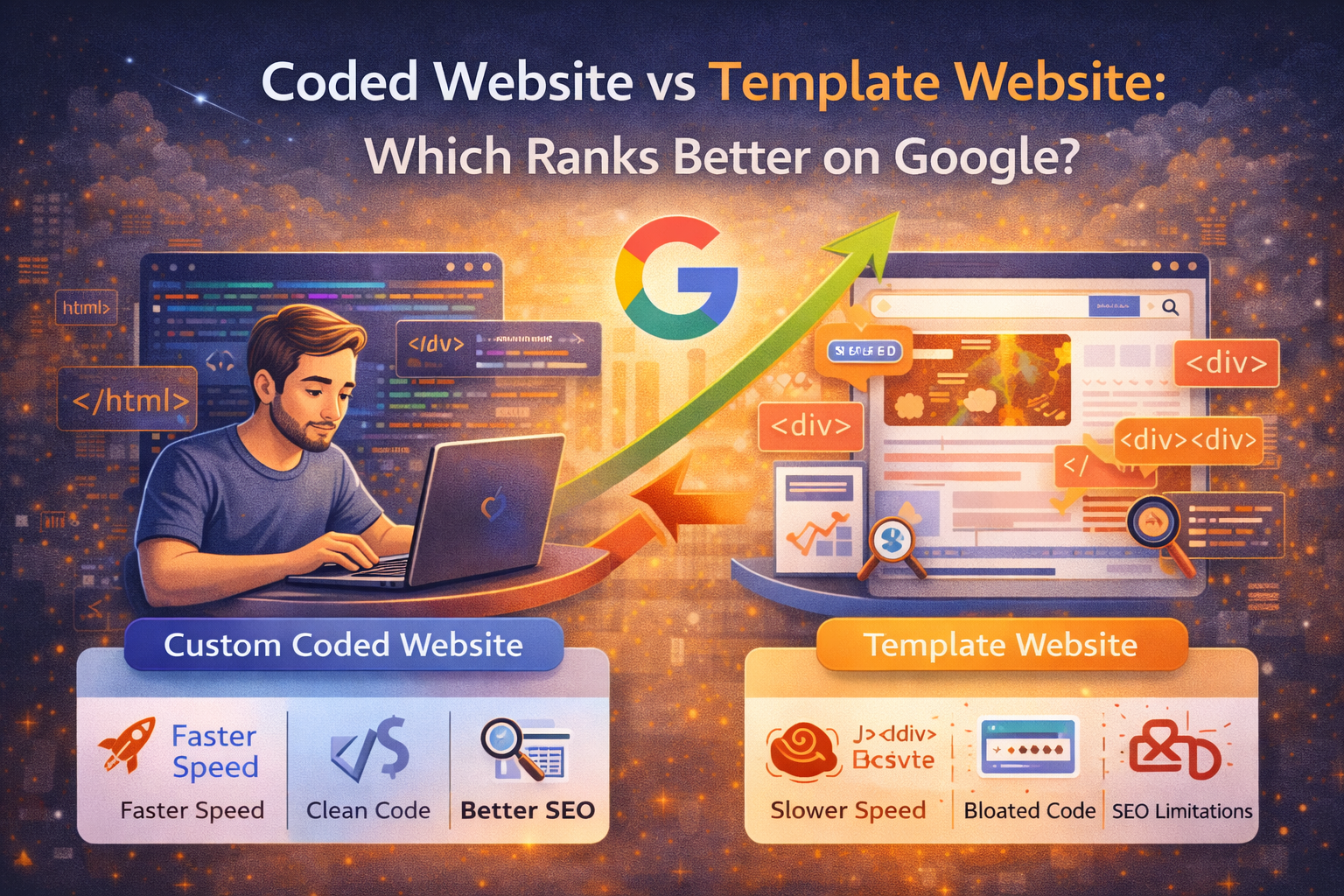
When businesses plan a new website, one of the most common questions is:
Should we build a custom-coded website or use a template?
The decision isn’t just about design or cost—it has a direct impact on SEO and Google rankings. From website speed to crawlability and long-term scalability, the way your website is built plays a crucial role in how search engines evaluate it.
In this detailed guide, we’ll compare custom coded website SEO and template website SEO performance to help you understand which option truly ranks better on Google—and why.
🔍 Understanding How Google Ranks Websites
Before comparing website types, it’s important to understand what Google actually looks for.
🧠 Key Google Ranking Factors for Websites
Some major Google ranking factors website evaluation includes:
-
Page speed
-
Mobile responsiveness
-
Clean code structure
-
Core Web Vitals
-
Crawlability and indexing
-
User experience
Both coded and template websites can rank—but how efficiently they meet these factors is where the difference lies.
🧩 What Is a Custom Coded Website?
A custom-coded website is built from scratch using technologies like HTML, CSS, JavaScript, and backend frameworks—without relying on pre-built themes.
✅ Benefits of Custom Coding
With custom website development benefits, businesses gain:
-
Full control over structure
-
Optimized performance
-
Scalable architecture
-
Clean, minimal code
This directly supports SEO friendly website structure and long-term growth.
📦 What Is a Template Website?
Template websites use pre-designed themes from platforms like WordPress, Wix, or Shopify.
⚠️ Common Template Limitations
While templates are faster to launch, they come with template website limitations such as:
-
Bloated code
-
Unused scripts and plugins
-
Limited technical customization
These issues can negatively affect website performance ranking.
⚙️ Website Code Optimization: The Core Difference
🧼 Clean Code vs Bloated Code
Search engines prefer websites with clean code for SEO.
Custom-Coded Websites:
-
Only required code is used
-
Faster rendering
-
Easier crawling
Template Websites:
-
Extra CSS & JavaScript
-
Plugin dependencies
-
Slower processing
This makes website code optimization far more effective with custom builds.
🚀 Page Speed and SEO: Who Wins?
Page speed and SEO are tightly connected.
⏱️ Speed Comparison
Custom-coded websites:
-
Faster load times
-
Optimized assets
-
Better server efficiency
Template websites:
-
Heavier files
-
Plugin delays
-
Slower Core Web Vitals
Speed advantages lead to stronger website performance ranking signals.
📊 Core Web Vitals Impact on Rankings
Google heavily prioritizes Core Web Vitals impact:
-
LCP (Largest Contentful Paint)
-
FID (First Input Delay)
-
CLS (Cumulative Layout Shift)
Custom-coded websites are easier to optimize for these metrics, while template sites often struggle due to rigid layouts and scripts.
🕷️ Crawlability and Indexing Advantages
🔎 How Google Crawls Your Site
Google bots rely on structure to understand content.
A custom-coded site allows:
-
Logical HTML hierarchy
-
Optimized internal linking
-
Better website crawlability improvements
Template websites often include:
-
Nested divs
-
Redundant markup
-
Auto-generated URLs
This affects search engine friendly design and indexing efficiency.
🏗️ On-Site SEO Architecture Comparison
🧱 Custom SEO Architecture
With custom builds, on site SEO architecture can be:
-
Tailored URL structures
-
Optimized heading flow
-
Schema-ready markup
🧱 Template SEO Architecture
Templates often restrict:
-
URL customization
-
Schema flexibility
-
Technical SEO control
This creates a clear technical SEO comparison gap.
🔐 Security & Technical Stability
Security indirectly affects SEO.
Custom-coded websites:
-
Fewer vulnerabilities
-
No unnecessary plugins
-
Better performance stability
Template websites:
-
Plugin-based security risks
-
Frequent compatibility issues
Security stability contributes to consistent website performance ranking.
📈 Long-Term SEO Scalability
SEO is not short-term.
🌱 Custom Websites Scale Better
With custom website development benefits, businesses can:
-
Add features without slowdown
-
Optimize continuously
-
Expand content architecture
Template websites may hit performance ceilings as traffic and features grow.
⚠️ When Template Websites Still Make Sense
Template websites can still rank if:
-
Properly optimized
-
Minimal plugins used
-
Speed and structure managed
However, achieving top performance requires constant fixes compared to custom builds.
🏆 Final Verdict: Which Ranks Better on Google?
🥇 The Clear Winner for SEO
While both can rank, custom coded website SEO consistently outperforms template website SEO performance in:
-
Speed
-
Clean code
-
Crawlability
-
Core Web Vitals
-
Long-term scalability
For businesses serious about SEO, growth, and performance, custom-coded websites provide a clear competitive edge.
✅ Final Thoughts
Google doesn’t rank templates or custom code—it ranks performance, structure, and experience.
But custom-coded websites make it significantly easier to meet and exceed Google’s ranking standards. If SEO is a priority for your business, investing in clean code and technical flexibility is a smart long-term decision.
❓ FAQs
Q1. Do custom-coded websites rank better than templates?
Yes, custom-coded websites usually perform better due to clean code, faster speed, and better SEO control.
Q2. Can template websites rank on Google?
Yes, but they require extra optimization and still face technical limitations.
Q3. How does code quality affect SEO?
Clean, optimized code improves crawlability, speed, and Core Web Vitals—all critical ranking factors.
Q4. Are custom websites better for long-term SEO?
Yes, they scale better and allow continuous SEO improvements without performance loss.
Q5. Which is better for Core Web Vitals?
Custom-coded websites are easier to optimize for Core Web Vitals than template-based sites.