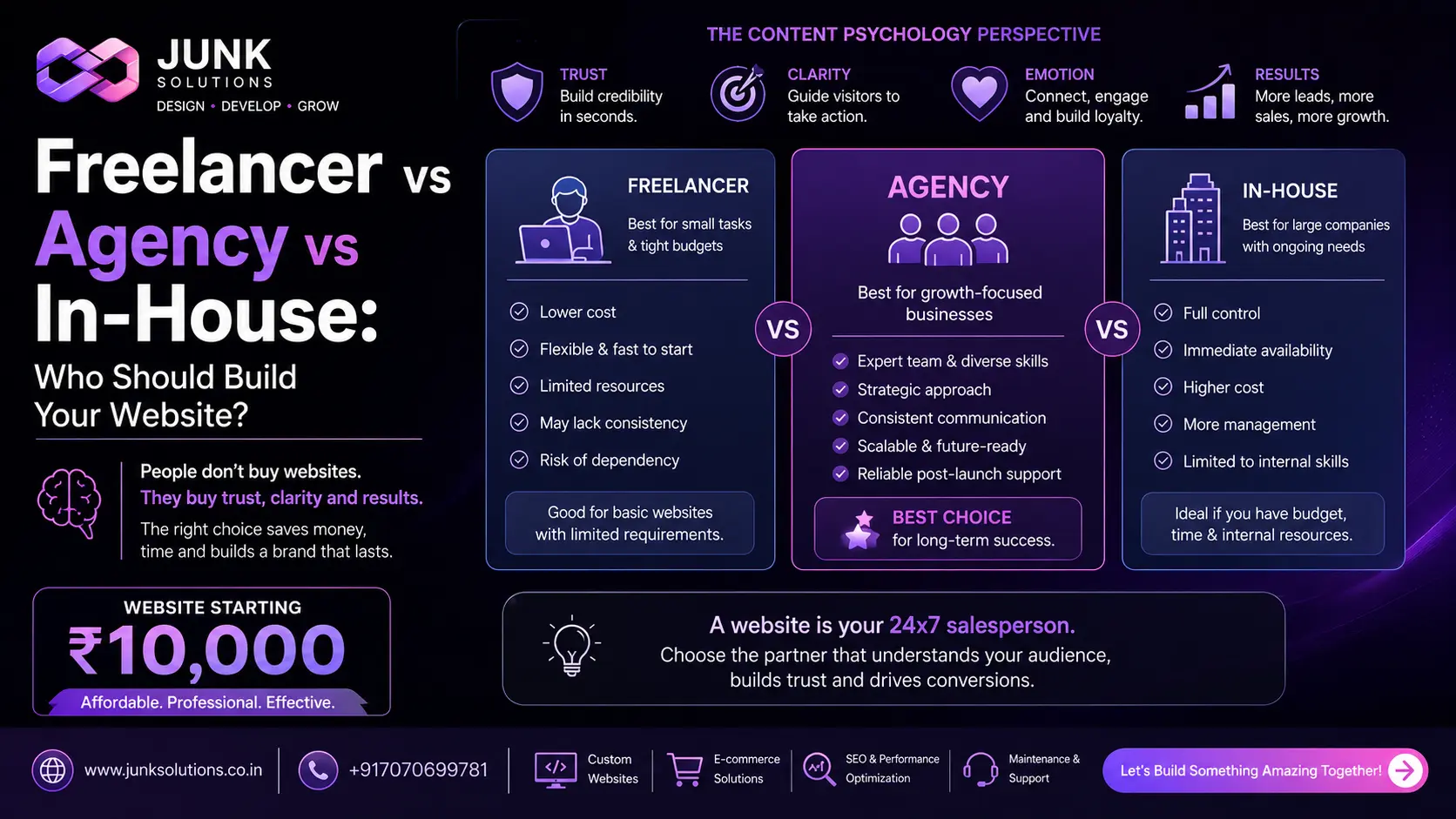
At some point, every business trying to build or rebuild a website runs into the same fork in the road. Do you hire a freelancer? Bring in a web development agency? Or build out an in-house team and own the whole thing yourself? The answer changes your budget, your timeline, and honestly, your stress levels for the next several months — and most of the advice out there is written by agencies trying to sell you an agency, which isn't exactly neutral ground.
This isn't that. What follows is a genuinely practical look at all three paths, what each one actually costs once you account for the parts nobody mentions upfront, and where each option tends to fall apart. The short version, which we'll spend the rest of this piece backing up: for most businesses — startups, SMEs, and even a lot of mid-sized companies — a skilled freelance website developer is the smartest starting point, and agencies and in-house teams earn their higher cost only in specific, identifiable situations.
The Three Options, Briefly
Before getting into detail, it helps to define what each path actually looks like in practice, because the terms get used loosely.
A freelance website developer is an independent professional — sometimes a solo generalist, sometimes a specialist in a particular platform or stack — who you hire directly for a defined project or ongoing work. No agency sits between you and the person writing the code.
A web development agency is a company employing multiple developers, designers, project managers, and often account managers, structured to take on client projects at scale. You're paying for the agency's process and infrastructure as much as for any individual person's time.
An in-house team means hiring developers directly as employees, building website work into your company's own payroll and management structure rather than contracting it out to anyone.
Each of these solves the "who builds the website" problem differently, and each comes with a completely different cost structure hiding underneath the sticker price.
What You're Actually Paying For (Not Just the Quote)
This is where most comparisons go wrong — they compare quotes side by side without accounting for what's bundled into each number and what's quietly left out.
A freelancer's quote is close to the real cost of the work. There's no office lease, no account manager's salary, no sales team commission baked into the number you're seeing — you're paying largely for the actual development hours going into your project. This is the core reason freelance website developer rates tend to run meaningfully lower than agency rates for comparable output: you're not subsidizing anyone else's overhead.
An agency's quote includes all of that overhead, whether or not you ever interact with the people it's paying for. Every agency project quietly funds an office, a sales process, project managers who aren't writing code, and a margin built in above what the actual developer is being paid. None of that is dishonest — it's how agencies function — but it means a portion of every rupee you spend isn't going toward your website at all.
An in-house hire's true cost goes considerably beyond salary. Add benefits, payroll taxes, recruiting cost, onboarding time, equipment, and the ongoing management overhead of having an employee, and the realistic multiplier on a developer's base salary typically lands somewhere between 1.25x and 1.4x once everything is accounted for. A developer earning ₹8 lakh a year is closer to a ₹10–11 lakh real cost to the business once you add all of that in — and that's before you've shipped a single feature.
Why Freelancers Tend to Win on Direct Communication
There's a structural problem baked into agency work that has nothing to do with the quality of any individual agency: the person you talk to during sales usually isn't the person writing your code. Requirements get relayed through an account manager, sometimes through a project manager on top of that, and by the time your explanation of what you actually need reaches the developer, something has usually gotten lost or reinterpreted along the way.
Hiring a freelance website developer collapses that chain entirely. You explain what you need directly to the person building it. Questions get answered immediately, without a middleman translating your intent through a second or third party. Misunderstandings that would otherwise take a full round-trip through an account manager to surface and correct get caught in the same conversation they came up in.
This matters more than it sounds like on paper. A huge share of website project delays and cost overruns trace back not to technical difficulty, but to miscommunication about what was actually being requested — a feature described one way to a salesperson and built a different way by a developer three steps removed from the original conversation. Freelancers structurally can't have that problem, because there's no chain to lose information across.
The Cost Comparison, Realistically
Numbers help ground this. For a standard professional business website — five to fifteen pages, mobile responsive, basic SEO structure, a working contact process — here's roughly how the three paths compare in India's current market:
A freelance website developer typically quotes somewhere between ₹15,000 and ₹80,000 for this scope, depending on experience level and complexity. A web development agency quoting the same scope typically lands between ₹50,000 and ₹2,50,000 or more for comparable work — not because the underlying development is that much harder, but because you're funding the agency's structure alongside the build itself.
An in-house hire doesn't really have a comparable one-time number, because you're not paying per-project — you're paying an ongoing salary regardless of whether there's website work to do in a given month. A junior-to-mid-level developer's annual cost, fully loaded, typically runs ₹6–12 lakh a year. If your business only needs meaningful website work a few times a year, that annual cost dwarfs what a freelancer or even an agency would have charged for the same actual output.
This is the math that quietly favors freelancers for most businesses: you're paying close to the real cost of the work, without either an agency's overhead margin or an employee's year-round salary sitting on top of it.
Custom Website Development: Who Actually Delivers It Well
"Custom website development" gets used as a marketing phrase by nearly everyone, so it's worth being specific about what it should actually mean: a site built around your specific business requirements and customer journey, rather than a generic structure with your logo dropped in.
A skilled freelance website developer is frequently better positioned to deliver genuinely custom web development than a mid-tier agency, for a reason that isn't obvious until you've seen it happen: agencies handling high project volume have a structural incentive to reuse components, templates, and patterns across clients to protect their margins. A freelancer taking on one project at a time doesn't have that same pressure diluting the customization you're paying for.
This isn't universal — a strong agency with a genuinely custom-focused process exists, and a weak freelancer can absolutely deliver a templated result dressed up as custom work. But the incentive structure tilts toward freelancers actually spending the attention that "custom" implies, since their reputation and repeat business depend entirely on the quality of each individual project, not on volume throughput.
Where Website Development Services Actually Get Delivered
Website development services, broadly, break down into a similar set of tasks whether you're hiring a freelancer, an agency, or building in-house: design, frontend development, backend development where needed, SEO structure, testing, and deployment.
What differs isn't the list of tasks — it's who's actually doing each one and how much distance sits between you and that person. With a freelancer, you typically know exactly who is doing which part of the work, even if they're bringing in occasional help for specialized pieces. With an agency, the person doing your SEO structure may be someone you've never spoken with, working from a brief that's been through two or three people since your original conversation. With in-house, you have full visibility, but you're also carrying the full cost of that visibility year-round.
For most single-project needs — building or rebuilding one business website — the freelancer path gives you nearly the same visibility as in-house, at a fraction of the ongoing cost, and considerably more visibility than the typical agency structure provides.
Where Freelancers Genuinely Fall Short
None of this is an argument that freelancers are always the right call — they're not, and pretending otherwise would be doing you a disservice. There are real, specific situations where a freelance website developer is a poor fit, and it's worth naming them honestly.
Scalability. A solo freelancer has a hard ceiling on how much work they can take on at once. If your project needs five specialists working in parallel — a designer, a backend developer, a frontend developer, a QA person, and someone managing deployment — a single freelancer simply can't be all five people simultaneously, no matter how skilled they are. Agencies exist partly to solve exactly this problem, since they can staff multiple specialists onto a large project at the same time in a way one person structurally cannot.
Availability. Freelancers get sick, take vacations, and sometimes take on other clients whose timelines collide with yours. There's no backup developer waiting in the wings if your freelancer becomes unavailable mid-project, whereas an agency has redundancy built in — if one team member is out, someone else can usually step in without your project grinding to a halt.
Accountability on very large projects. For a small business website, a freelancer's personal reputation is enough accountability — bad work spreads through reviews and referrals fast enough to matter. For a large, business-critical platform where a failure could mean serious financial or legal exposure, some businesses reasonably want the formal contracts, SLAs, and institutional accountability that come with a registered agency rather than an individual's personal assurance.
Long-term platform ownership. If your website is genuinely central to the business — not just a marketing site, but core infrastructure that needs constant iteration, security monitoring, and rapid response to problems — an in-house team's undivided attention starts to make more sense than intermittent freelance engagements, even at the higher fully-loaded cost.
The honest takeaway here: these are edge cases, not the norm. Most businesses building or rebuilding a standard website — even a fairly full-featured one — don't actually have five-person, multi-specialist requirements. They have a project a competent freelancer can realistically deliver end to end, and the scalability and availability concerns above only really bite once a project crosses into genuinely large or mission-critical territory.
When a Web Development Agency Is Worth the Extra Cost
Given everything above, there are still legitimate reasons to choose a web development agency over a freelancer, and it's worth being specific about when that trade-off actually makes sense rather than treating agencies as a default.
If your project genuinely requires multiple specialists working in parallel to hit a tight deadline, an agency's staffing capacity solves a problem a freelancer structurally can't. If you need the formal accountability of contracts, SLAs, and an institutional entity behind the work — particularly relevant for larger enterprises with procurement or compliance requirements that simply won't accept "hired an individual off a freelance platform" as an answer — an agency provides that in a way an individual freelancer generally can't. And if you've already tried freelancers and had a bad experience with reliability or communication, a reputable agency's structured process can be worth paying for as insurance against a repeat of that experience.
A professional website development company earns its premium in these situations specifically: complex, large-scale, or high-stakes projects where the coordination and redundancy of a full team genuinely outweighs the cost savings and directness of working with one person.
When In-House Makes Sense
In-house development earns its considerably higher ongoing cost in a narrower set of circumstances than either freelance or agency work: when your website (or web application) is not a marketing asset but the actual product, or close to it.
A company whose core business runs through a web platform — a SaaS product, an online marketplace, anything where the site is generating continuous revenue and needs continuous, rapid iteration — benefits from developers who understand the business deeply, are available immediately when something breaks, and aren't splitting attention across other clients' priorities. At that point, the fully-loaded cost of an in-house hire stops looking expensive relative to what a slow response to a critical bug or an unavailable freelancer at the wrong moment would actually cost the business.
For the majority of businesses — a professional services firm, a local business, most SMEs whose website supports the business rather than being the business — this threshold simply doesn't apply. Building an in-house team for occasional website work is roughly equivalent to hiring a full-time driver because you occasionally need a car moved.
SEO Isn't a Separate Line Item — It's Part of the Build
Website development and SEO get treated as two separate purchases far too often, and that separation tends to cost businesses money and rankings they didn't need to lose. SEO website development — building search-friendly foundations into the site from the start rather than retrofitting them afterward — is dramatically cheaper and more effective than hiring an SEO specialist after the fact to fix a site that wasn't built with clean URLs, proper heading structure, or fast load times in mind.
This is actually another point in favor of a skilled freelance developer over a large agency, counterintuitively: a freelancer who understands both development and SEO fundamentals can build those foundations in as a default, without you needing to coordinate between a development team and a separate SEO team who may never actually talk to each other. Larger agencies sometimes split "the website part" and "the SEO part" across entirely different departments or subcontractors, which reintroduces exactly the communication-chain problem freelancers avoid by design.
Marketing and Development Need to Talk to Each Other
Similarly, website development and marketing shouldn't be treated as unrelated purchases handled by unrelated vendors. A site built without any awareness of the marketing campaigns that will drive traffic to it — landing pages that don't match ad messaging, a homepage that ignores the actual customer journey a marketing team has mapped out — routinely underperforms a site built with that context in mind from day one.
A web development and digital marketing company that handles both under one roof can, in theory, solve this by keeping design and marketing decisions in sync. In practice, this benefit shows up more reliably with a freelancer who takes the time to actually understand your marketing goals during the build than with a large agency where the web team and the marketing team sit in different departments and coordinate through status meetings rather than direct collaboration.
Web Design and Optimization: An Ongoing Job, Not a One-Time Delivery
Web design and optimization doesn't end at launch, regardless of who builds the site. Page speed needs monitoring. Conversion paths need testing against real user behavior. Mobile experience needs revisiting as devices and screen sizes shift. Whoever builds your site initially should ideally be available for this ongoing work too, rather than disappearing the moment the invoice is paid.
This is where freelancer relationships often outperform both agencies and in-house teams on a specific, underrated dimension: continuity. A freelancer who built your site the first time already understands its structure, your business, and your goals — bringing them back for optimization work months later is far more efficient than onboarding a new agency team, or than an in-house hire ramping up on a codebase they didn't originally build.
How to Actually Evaluate a Freelance Website Developer
If the case above has you leaning toward hiring a freelancer, the natural next question is how to tell a genuinely skilled one from someone who'll disappear mid-project or deliver something that needs a rebuild in six months.
Ask to see live examples of their previous work, not just screenshots — test load speed and mobile responsiveness yourself rather than taking their word for it. Ask specifically about their process for requirements gathering, revisions, and post-launch support, since vague answers here predict vague delivery later. Check whether they can speak knowledgeably about SEO fundamentals and basic security practices, not just visual design, since a freelancer who treats those as someone else's problem is passing that gap directly onto you. And get clear, written terms on ownership — you should own the final code, domain, and hosting credentials outright once the project is paid for, with nothing held back.
A freelancer who answers all of this specifically and confidently is a strong signal. Vague reassurances, reluctance to share verifiable past work, or evasiveness about ownership terms are the same red flags that would concern you about an agency — the format of the working relationship doesn't change what good process actually looks like.
Choosing the Best Fit, Not the Default Option
None of this is an argument that freelancers are correct in every situation, or that agencies and in-house teams don't have real, legitimate use cases. It's an argument that the default assumption many businesses make — that a bigger, more expensive option is automatically the safer or more professional choice — doesn't hold up once you actually compare what each option delivers against what it costs.
The best website development company for a given project might genuinely be an agency, if your requirements involve multiple specialists working in parallel, formal procurement requirements, or genuinely large scope. It might be an in-house hire, if your website is core, revenue-generating infrastructure that needs constant, dedicated attention. But for the large majority of businesses building or rebuilding a standard website — the SME with a five-to-fifteen-page business site, the startup that needs a professional online presence without burning through runway, the local business that wants something better than a template — a skilled freelance website developer typically delivers comparable or better direct communication, comparable or better custom development attention, and a meaningfully lower cost than either alternative.
Matching the Option to What You're Actually Building
It helps to walk through a few concrete scenarios, since abstract advice about "choosing the right fit" only goes so far.
If you're a solo founder or a small team that needs to build custom website infrastructure for the first time — a proper business site with lead capture, basic SEO, and room to grow — a freelancer website developer is very often the right starting point. You get build custom website work shaped specifically around your business, without paying for agency infrastructure you don't need yet.
If you're a marketing or ops lead at a mid-sized company evaluating vendors, you'll likely see a mix of freelancer website developer profiles, boutique studios, and larger web development agency proposals in the same search. The proposals will look superficially similar — website design and development services, custom web development company, professional-sounding language across the board — but the underlying delivery model differs enormously, for all the reasons covered above. Read past the pitch to the actual process: who does the work, how revisions are handled, and what happens after launch.
If you're evaluating a web design and development company specifically because your project needs both strong visual design and solid engineering in equal measure, look closely at whether that's genuinely one integrated team or two departments that happen to share a letterhead. The same question applies whether you're talking to a custom website development company, a smaller studio, or an individual freelancer who subcontracts a designer for larger projects — integration matters more than the label on the business card.
And if your primary need is web development services broadly — ongoing technical support rather than a single launch — think carefully about whether that's better served by a retainer relationship with a trusted freelancer, a maintenance package from an agency, or, if the workload genuinely justifies it, bringing someone in-house. Each path solves "ongoing support" differently, and the right one depends entirely on how much ongoing work there actually is.
Final Thoughts
The question was never really "freelancer or agency or in-house" as an abstract preference. It's a practical trade-off between cost, communication, scalability, and accountability, and for most standard website projects, that trade-off tips clearly toward freelancers: lower cost because you're not funding someone else's overhead, more direct communication because there's no chain of people relaying your requirements, and genuinely custom attention because a freelancer's business depends on doing right by each individual project rather than maximizing volume.
Agencies and in-house teams earn their higher cost in real, identifiable situations — large parallel workloads, formal accountability requirements, or a website that functions as core business infrastructure rather than a marketing asset. Outside those situations, paying agency-level overhead or carrying a year-round salary for what a skilled freelancer can deliver directly is usually money spent on reassurance rather than on anything your website actually needs.
FAQs
1. Is it actually cheaper to hire a freelance website developer than an agency? Generally yes, often significantly so. A freelancer's quote reflects mostly the actual development work, while an agency's quote includes overhead like office costs, account management, and a built-in profit margin layered above the developer's actual pay. For comparable scope, freelancers in India often run ₹15,000–₹80,000 versus ₹50,000–₹2,50,000+ for an agency.
2. When should I choose an agency over a freelancer? When your project genuinely needs multiple specialists working simultaneously to meet a tight deadline, when you need formal contracts and SLAs for compliance or procurement reasons, or when you've had a bad prior experience with freelance reliability and want the redundancy an agency provides.
3. Is a freelancer risky for a business-critical website? It depends on the project's scale and stakes. For a standard business website, a reputable freelancer with verifiable past work is a reasonable and often lower-risk choice. For genuinely large, high-stakes platforms — especially those with significant financial or legal exposure — the formal accountability of an agency or the dedicated attention of an in-house team becomes more valuable.
4. What does "custom website development" actually mean, and does a freelancer deliver it better than an agency? Custom development means building a site around your specific business and customer journey rather than adapting a generic template. Freelancers are often well-positioned to deliver genuinely custom work because their business depends on individual project quality rather than volume, though a strong agency can deliver this too if their process is genuinely built around it.
5. How much does an in-house developer actually cost compared to hiring a freelancer per project? An in-house developer's fully-loaded annual cost — salary plus benefits, taxes, recruiting, and management overhead — typically runs 1.25x to 1.4x their base salary. For most businesses that only need website work intermittently, this ongoing cost far exceeds what freelance or agency work would cost for the same actual output.
6. Do freelancers handle SEO and website development together, or do I need to hire separately? A skilled freelance website developer can typically build SEO fundamentals — clean URLs, proper heading structure, fast load times — into the site as a default. This avoids the coordination gap that sometimes occurs at larger agencies where development and SEO are handled by separate teams.
7. What should I look for when evaluating a freelance website developer? Ask to see live, working examples of past projects rather than screenshots, ask specific questions about their process for requirements and revisions, confirm they understand basic SEO and security practices, and get written confirmation that you'll own the final code, domain, and hosting outright.
8. Can a freelancer handle ongoing website maintenance and optimization, or only the initial build? Many freelancers offer ongoing maintenance and optimization, and there's a real advantage to continuity here — a freelancer who built your site already understands its structure, saving the ramp-up time a new agency team or in-house hire would need to get up to speed.
9. Is it harder to hold a freelancer accountable compared to an agency? Structurally, an agency offers more formal accountability through contracts and institutional presence. In practice, a freelancer's reputation and referral-based business model creates strong practical accountability for smaller projects, though very large or high-stakes projects may still warrant the added formality an agency provides.
10. What's the biggest mistake businesses make when choosing between these three options? Assuming the more expensive option is automatically safer or more professional. For most standard website projects, that assumption doesn't hold up — a skilled freelancer often delivers comparable or better results at meaningfully lower cost, and agencies or in-house teams only earn their premium in specific situations involving scale, formal accountability needs, or core business infrastructure.