The Tech Boom in God’s Own Country
Kerala's digital landscape has completely transformed. With massive IT hubs like Infopark in Kochi, Technopark in Trivandrum, and Cyberpark in Kozhikode expanding rapidly, the state is churning out serious engineering talent. The startup culture here is thriving, supported by a highly educated workforce.
When you hire a local developer in Kerala, you are tapping into a talent pool that builds to global standards. Because these tech hubs handle so many international projects, the developers are deeply exposed to cutting-edge coding practices.
But the real edge is their local context. A developer in Kerala understands that your audience might require robust Malayalam content support. They know the exact payment gateways people actually trust here and exactly how to optimize your local SEO. This localized knowledge gives you a massive competitive advantage.
Freelancer vs. Agency: Which Route?
Your first big choice is deciding between an independent freelancer or a full agency. Both routes are valid, but they serve completely different purposes.
The Case for the Independent Freelancer
For most small to medium businesses, an independent freelancer is often the smartest move. You get direct access to the person actually writing your code. There are no project managers slowing down communication—if you need a headline tweaked or a button color changed, it happens in minutes.
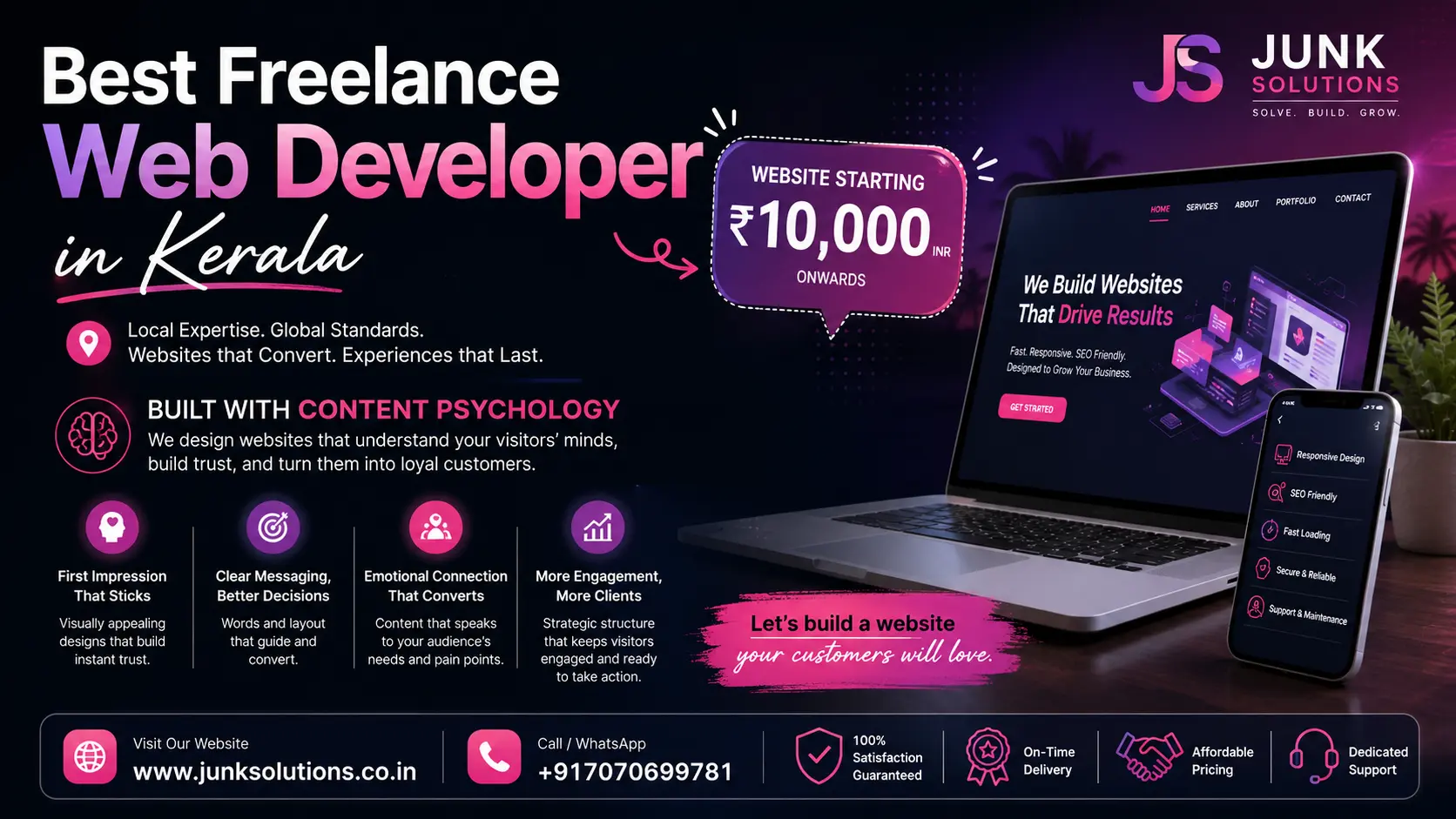
Financially, freelancers are incredibly attractive. Without the massive overhead costs of running a premium IT office, they can offer high-level skills at a fraction of the agency price. In 2026, freelance hourly rates in Kerala's tech hubs (Kochi, Trivandrum, Kozhikode) typically range from ₹500 to ₹2,000 per hour. This rate is routinely 30-50% cheaper than hiring equivalent talent in Bangalore. A beginner freelance developer will generally charge between ₹10,000 and ₹50,000 on average for a complete project.
When You Actually Need an Agency
If you are building a massive enterprise software platform, a complex multi-vendor marketplace, or an application handling sensitive data, a solo developer might get overwhelmed. That is when you need the structural safety net of an agency. They bring dedicated UI/UX designers, frontend coders, backend architects, and QA testers all working together. It costs more, but for high-risk projects, it is absolutely necessary.
The 2026 Pricing Reality
Web development pricing in India is notoriously confusing. You can ask three developers for a quote and get three wildly different numbers. The truth is, you get exactly what you pay for. A website is a highly customized business asset, not a commodity.
Beware the ultra-cheap trap. Those ads offering websites for ₹4,000 usually rely on bloated, pirated templates. They look identical to thousands of other sites, load incredibly slowly, and offer zero custom functionality.
Here is a realistic breakdown of what you should expect to pay in 2026:
-
Basic Landing Page: ₹4,000 to ₹12,000. Perfect for a solo consultant or a small local shop needing a clean digital footprint.
-
Standard Business Website: Starting around ₹20,000. This is the sweet spot for most SMEs, covering a solid SEO foundation, blogging capabilities, and clean code.
-
Custom-Designed Business Website: ₹25,000 to ₹1,50,000+. If you need a completely unique visual identity, complex animations, dual Malayalam/English support, and advanced performance tuning, this is the budget you need.
-
E-Commerce Stores: A solid WooCommerce or Shopify setup generally starts at ₹35,000.
Don't forget the hidden costs. You will need to pay for domain name renewals (typically ₹800 to ₹2,000 per year), reliable web hosting, and premium plugin licenses. It is highly recommended to sign an Annual Maintenance Contract (AMC) so someone is actively keeping your software updated and secure.
Why Custom Builds Beat Templates
The days of getting away with a generic template are long gone. Consumers can spot a cheap site instantly. Templates are built for the masses, meaning they are packed with features and heavy sliders you will never actually use. All that extra code just forces the browser to work overtime, killing your page load speed.
A custom build means every line of code serves your specific business logic. It's lean, blazingly fast, and actually unique to your brand. It also scales effortlessly—if your business pivots and you suddenly need to add a custom booking portal, a bespoke architecture handles it without breaking.
Selling Online? The Stakes Are Higher
E-commerce is a completely different beast than a standard informational brochure site. You are handling payment data, which means security has to be ironclad.
The checkout flow is make-or-break. Your developer needs real experience integrating local gateways like Razorpay or PayU seamlessly. And a strict mobile-first design philosophy is mandatory. The vast majority of your e-commerce traffic will come directly from smartphones. If your store's buttons aren't thumb-friendly or the images take forever to load on cellular data, you will lose sales.
The Ultimate Hiring Checklist
Making the final hiring decision is stressful. To make sure you hire the absolute best talent, run through this strict evaluation process before signing anything:
-
Test Live Portfolios: Do not just look at flat screenshots sent in a PDF. Click through their recent live sites on your own phone and test exactly how fast they load.
-
Verify Local Context: Do they understand bilingual setups? Do they know which payment gateways perform best locally?
-
Lock Down Legal Ownership: Ensure your contract explicitly states that you retain 100% ownership of all source code, design files, and domain assets upon final payment.
-
Review Communication Style: Are they responsive? Do they explain complex technical concepts in plain, easy-to-understand English rather than hiding behind jargon?
-
Plan for Maintenance: Ask exactly what happens if the site breaks a month after launch and ensure they offer an ongoing maintenance retainer.
As business owners increasingly realize the value of high-quality digital assets, looking at standards set by successful national agencies can be incredibly helpful. For example, the level of technical precision and humanized content strategies employed by experts like Abhijeet Kumar at junksolutions.co.in in Delhi serves as a fantastic benchmark. You want your Kerala-based developer to bring that exact same level of elite national standard to your local project, ensuring you dominate your specific market niche.