There's a specific moment that happens on almost every website, and most businesses never see it because it doesn't show up in any dashboard. A visitor arrives, waits half a second too long for the page to load, and leaves — not annoyed, exactly, just gone. No complaint, no bounce-rate alert flashing red, just one fewer customer than there should have been. Multiply that moment by every slow page load, every clunky mobile experience, every confusing checkout, and you start to understand why two businesses selling the exact same thing can have wildly different conversion numbers with nothing to do with price or product.
This is the part of running a business that's easy to underestimate: a high performance website design isn't a technical nice-to-have sitting off to the side of your marketing. It's doing a huge share of the actual selling, and it's either helping you or quietly working against you right now.
Below is what actually separates a fast, trustworthy, sales-generating website from one that just happens to exist.
Speed Isn't a Feature — It's the First Impression
Ask most people what makes them trust a website and they'll mention design, maybe reviews, maybe professionalism. Almost nobody says "speed," and yet speed is doing more work than any of those things before a visitor even registers what the page looks like.
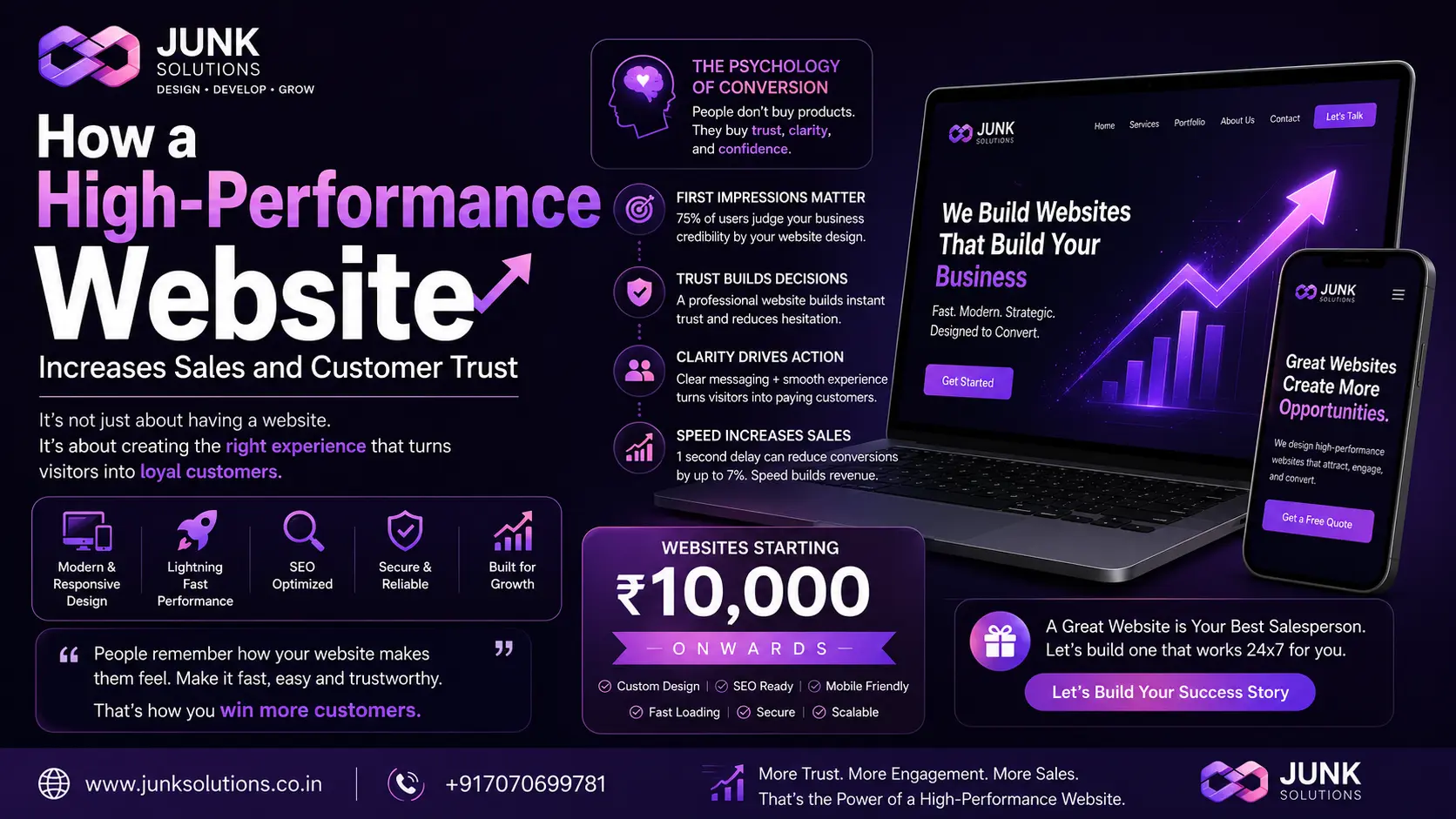
Website speed optimization changes buying behavior in a very direct, measurable way. Every additional second of load time chips away at conversion rates — this isn't a marginal effect, it's one of the largest single levers a business has, and it's often the cheapest to fix. A fast loading website development approach — compressed images, efficient code, a decent hosting setup — routinely outperforms a slower competitor with a nicer-looking homepage, because most visitors never stick around long enough to appreciate the nicer homepage.
There's a trust dimension buried in here too. A site that loads instantly signals competence before a single word gets read. A site that stutters and lags signals the opposite, whether or not that's a fair read on the actual business behind it.
Responsive Design Is Where Most Sales Quietly Die
More than half of all web traffic arrives on a phone now, and for plenty of industries that share is considerably higher. Responsive website design — the layout automatically adjusting to fit whatever device it's viewed on — has gone from differentiator to baseline requirement in the space of a few years.
Here's the part that gets missed: a site can look fantastic on a laptop and still be quietly killing conversions on mobile, where most of the actual traffic lives. Text too small to read without zooming. Buttons packed too close together to tap accurately. A checkout flow designed for a mouse and keyboard, forced onto a five-inch screen. None of that shows up if you're only ever testing the site on your own desktop, which is exactly why so many businesses don't catch it.
Google factors mobile experience directly into search rankings too, which means a weak mobile site is losing customers twice — once in visibility, and again the moment someone lands on it and gives up.
What "High-Performance" Actually Means in Practice
The phrase gets used loosely, so it's worth being specific. A genuinely high performance website design combines several things working together, not any single trick:
Fast server response times and efficient hosting. Optimized images and minimal unnecessary scripts. Clean code that browsers can render quickly. A layout that doesn't force unnecessary reflows as the page loads. Caching set up correctly so returning visitors get near-instant loads.
Miss any one of these and the others can't fully compensate. A site with gorgeous, optimized images sitting on cheap, overloaded hosting will still feel slow. A site with excellent hosting but bloated, unoptimized code will still lag. Performance is a chain, and it only moves as fast as its weakest link.
Design That's Actually Built for Sales Conversion
There's a real difference between a site that looks attractive and website design for sales conversion — design that's been deliberately structured around getting someone from curious to committed.
The second kind starts from a different question entirely: not "what should this section look like," but "what does a visitor need to see, in what order, before they're ready to buy or fill out a form." That usually shows up as a clear, plain-language value proposition near the top of the page, social proof placed exactly where doubt tends to creep in, calls to action that read like an actual next step rather than a vague nudge, and a path from first click to final decision that doesn't force anyone to hunt for what they need.
None of this requires sacrificing good design. It requires making sure good design is working toward an outcome, not just sitting there looking nice.
Custom Design Signals Investment, and Buyers Notice
Visitors have seen enough generic templates by now to spot one instantly, even without knowing exactly why something feels off. Custom website design for businesses signals that a company invested real time in getting the details right, rather than grabbing whatever came pre-built. Buyers read that investment as a rough proxy for how much the business cares about getting other things right too — support, product quality, follow-through.
This doesn't mean every business needs a site built entirely from scratch. It means the layout, messaging, and structure should feel like they were shaped around this specific business and its actual customers, not assembled from a theme built for nobody in particular. Custom web design solutions that start from your customers' actual buying process, rather than a generic template's assumptions, tend to convert meaningfully better over time.
Ecommerce Has Its Own Set of Rules
If you're running an online store, the stakes around performance and design go up considerably. Ecommerce website development carries requirements a standard business site doesn't have to deal with — product search that actually works, filtering that narrows results the way customers expect, a cart and checkout flow with as few steps as physically possible, and payment processing that feels secure without feeling like an interrogation.
Cart abandonment is largely a performance and friction problem in disguise. Slow product pages, confusing navigation, or a checkout that suddenly demands an account signup right before the final click — these are exactly the moments where a well-optimized ecommerce build pulls ahead of a merely decent one, and where sales get lost on sites that look fine but weren't built with the actual buying journey in mind.
Corporate and Business Sites Have Different Trust Signals
A corporate website design services approach isn't chasing the same goals as a small local business site, and it shouldn't look like it's trying to. Enterprise buyers and B2B decision-makers are evaluating credibility signals a consumer wouldn't think twice about — case studies with real detail, clear evidence of scale, security and compliance information easy to find rather than buried, and a site that reads as though a serious, established company is behind it.
Business website development company work aimed at this audience tends to prioritize depth over flash: detailed service pages, transparent process explanations, and proof points that hold up under scrutiny from someone doing due diligence before a large purchase decision, not just browsing casually.
SEO and Performance Are the Same Conversation
SEO friendly website development isn't a separate checklist bolted onto a finished site. Page speed, mobile responsiveness, clean heading structure, and proper technical setup are ranking factors and conversion factors at the same time — the things that help Google trust a page are, largely, the same things that help visitors trust it.
This is where working with a website development company that treats performance and SEO as one connected discipline pays off, rather than hiring separately for "the pretty part" and "the SEO part" and hoping the two teams' work lines up. A site that ranks well but loads slowly still loses the sale. A fast site that's invisible in search never gets the chance to make one.
Choosing the Right Development Partner
This is usually where things go wrong, so it's worth spending real time here. A best website developer for your specific situation isn't necessarily the one with the flashiest portfolio or the lowest quote — it's the one whose past work you can actually verify holds up, both technically and commercially. A top website design agency earns that reputation through results you can check, not through a well-produced pitch deck.
A few things worth checking before signing anything:
Ask to see live sites, not just screenshots, and test load speed and mobile behavior yourself. Ask directly about their approach to performance optimization, not just design aesthetics. Get clarity on what's included in the quote — hosting setup, SSL, post-launch support — since this is where "affordable" quotes often turn expensive later. Ask who you'll actually be working with day-to-day, since sales conversations and the actual build team aren't always the same people.
Professional web development firms should be able to answer all of this specifically, without vague reassurances. If you're searching "website developer near me" hoping local proximity solves the problem, proximity matters less than it used to — most development work happens remotely regardless of location, so the actual criteria (verified past work, clear process, technical depth) matter far more than geography.
Affordable Doesn't Have to Mean Compromised
Affordable website development packages get a bad reputation because "cheap" and "affordable" get treated as the same thing, and they're not. A reasonably priced package that includes proper hosting setup, mobile optimization, basic SEO structure, and post-launch support can absolutely deliver a high-performance result. What tends to actually hurt businesses is a rock-bottom quote that excludes all of that, then charges extra for each piece afterward — hosting configuration, SSL, security updates — until the total cost quietly exceeds what a transparent mid-range quote would have been from the start.
The smarter approach is a website development company in India, or wherever you're based, that's upfront about exactly what a given price includes, rather than the cheapest number on a comparison spreadsheet.
Getting a Professional Consultation Before You Commit
A professional website development consultation, done properly, should feel like a diagnostic conversation rather than a sales pitch. A development team worth hiring will ask about your business, your customers, and your goals before talking price or timeline — and should be able to point to specific, verifiable examples of solving problems similar to yours.
This step is easy to skip when you're in a hurry to get a project moving, and it's almost always a mistake to skip it. A short consultation surfaces mismatched expectations, unclear scope, and vague answers long before they become expensive problems mid-project.
Bringing It Together
Sales and trust online come from the same source: a website that loads fast, works cleanly on every device, and is built around how customers actually make decisions rather than how a designer wants a page to look. Speed, responsiveness, and conversion-focused design aren't separate boxes to tick off a list — they reinforce each other, and neglecting one quietly undermines the rest.
Businesses that treat their website as a finished, one-time project tend to watch performance erode slowly without ever pinpointing why, right up until a competitor with a faster, cleaner site starts pulling their customers away. Businesses that treat it as ongoing infrastructure — worth revisiting, testing, and improving — tend to be the ones whose sites are quietly outperforming everyone else's in the same market.
FAQs
1. How much does website speed actually affect sales? Significantly. Conversion rates drop sharply as load time increases, and much of that drop happens in the first two to three seconds. A slow site isn't just an inconvenience; it's actively costing sales before a visitor has read a single word of content.
2. What's the difference between a fast website and a high-performance website? Speed is one component of performance, but high-performance also includes mobile responsiveness, clean code, reliable uptime, and a layout that doesn't force unnecessary reloading or lag as a page renders. A site can load reasonably fast and still perform poorly if other elements aren't optimized.
3. Do I need a custom website, or is a template enough for my business? Templates work fine for very simple, low-stakes sites. If your website is a primary sales or lead-generation channel, custom website development services usually pay for themselves through better conversion rates, since the layout and flow can be shaped around your actual customers rather than a generic structure.
4. How do I find a website developer near me that's actually reliable? Location matters less than most people assume, since most development work happens remotely regardless of proximity. Focus instead on verifiable past work, clear communication during the sales process, and specific answers about performance, security, and post-launch support.
5. Is affordable website development always lower quality? Not necessarily. Affordable website development packages can deliver strong results if they include the essentials — proper hosting, mobile optimization, and basic SEO structure. The real risk is an unusually cheap quote that excludes those essentials and charges extra for them later.
6. Does ecommerce website development require anything different from a standard business site? Yes. Ecommerce sites need reliable product search and filtering, a short and frictionless checkout flow, and secure payment processing, on top of the same speed and mobile requirements every website has. Cart abandonment is frequently a performance or friction problem rather than a pricing one.
7. How does website design build customer trust? Visitors form judgments about a business's reliability within a fraction of a second of a page loading, based largely on speed and visual consistency. A website that builds customer trust tends to load quickly, look coherent across every page, and make information easy to find rather than making visitors dig for it.
8. What should I ask before hiring a web development company? Ask to see live examples of their work rather than screenshots, ask specifically about their approach to speed and mobile optimization, clarify exactly what's included in the quoted price, and ask who you'll actually be working with once the contract is signed.
9. Is SEO-friendly development different from regular website development? Not entirely separate — the technical foundations that help SEO, like clean code, proper heading structure, and fast load times, are largely the same foundations that improve user experience and conversions. SEO friendly website development should be a built-in default, not an optional add-on.
10. What happens during a professional website development consultation? A proper consultation focuses on understanding your business, goals, and customers before discussing price or timeline. It should also cover technical questions specific to your needs and give you a chance to evaluate the team's expertise before committing to a full project.