Most businesses invest in websites, ads, social media, and CRM tools—but still struggle with consistent growth. Why? Because these tools operate in isolation.
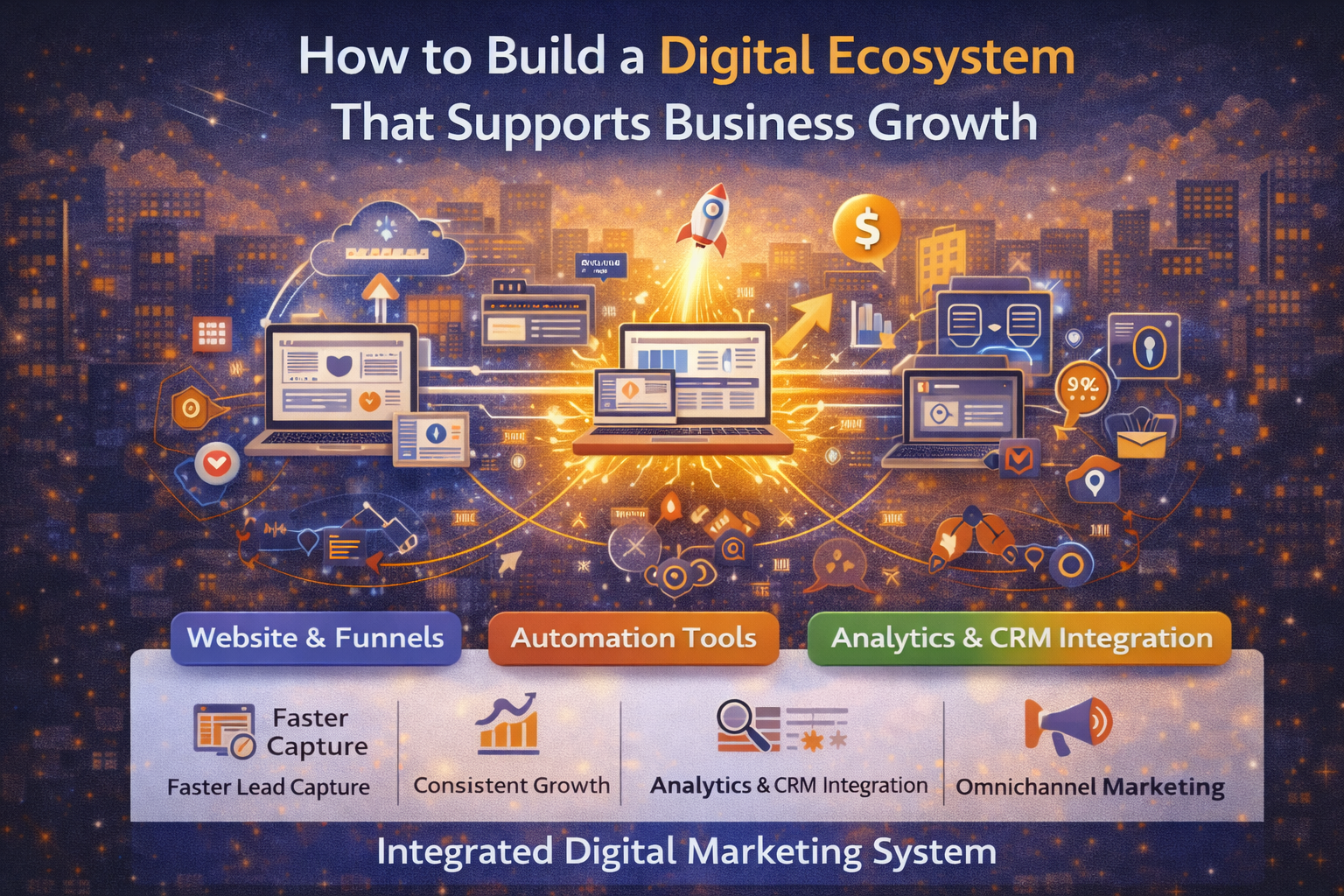
What modern companies truly need is a digital ecosystem for business—a connected, integrated, and scalable system where every digital component works together toward one goal: sustainable growth.
In this guide, we’ll break down how to build a powerful ecosystem that fuels long-term expansion, improves efficiency, and strengthens your business growth strategy online.
🌐 What Is a Digital Ecosystem?
A digital ecosystem for business is a network of connected digital platforms, tools, and strategies that work together to support marketing, sales, operations, and customer experience.
Instead of scattered efforts, you create a centralized digital strategy where:
-
Your website captures leads
-
Your CRM nurtures prospects
-
Your automation tools follow up
-
Your analytics track performance
This alignment creates a seamless growth engine.
🎯 Why Businesses Need an Integrated Digital Structure
Disconnected systems create inefficiencies:
-
Leads get lost
-
Data isn’t tracked properly
-
Marketing campaigns lack personalization
-
Teams work in silos
An integrated digital marketing system solves these issues by ensuring every channel communicates effectively.
This integration strengthens your overall business growth strategy online.
🧱 Core Components of a High-Performance Digital Ecosystem
🖥️ 1. Strong Digital Infrastructure
Your foundation starts with robust digital infrastructure for companies.
This includes:
-
Fast, optimized website
-
Secure hosting
-
Scalable backend systems
-
Structured database architecture
Without a strong technical base, scaling becomes difficult.
A well-built scalable digital framework ensures your systems grow as your traffic and operations expand.
🌍 2. Omnichannel Marketing Alignment
Customers interact with brands across multiple touchpoints.
An omnichannel marketing strategy ensures:
-
Consistent messaging across platforms
-
Seamless customer experiences
-
Unified data collection
Through connected marketing platforms, businesses can integrate social media, email, paid ads, and content marketing into one synchronized system.
🔗 3. Website and Funnel Integration
Your website alone isn’t enough.
By implementing website and funnel integration, you create:
-
Landing pages for campaigns
-
Automated lead capture systems
-
Conversion-focused user journeys
This supports customer journey optimization, guiding prospects from awareness to purchase efficiently.
🧠 4. CRM and Marketing Integration
A disconnected CRM limits growth.
Proper CRM and marketing integration allows you to:
-
Track user behavior
-
Personalize communication
-
Segment audiences effectively
This integration strengthens your lead nurturing system, ensuring no opportunity is missed.
⚙️ 5. Business Automation Tools
Manual processes slow growth.
With business automation tools, you can:
-
Automate follow-up emails
-
Trigger sales notifications
-
Schedule campaigns
-
Manage pipelines
Automation improves operational efficiency and supports online business scalability.
📊 6. Data-Driven Marketing Strategy
Data is the backbone of modern growth.
A data driven marketing strategy relies on:
-
Performance tracking
-
A/B testing
-
Customer behavior analysis
Using performance tracking tools, businesses can measure what works and refine strategies accordingly.
🛠️ 7. Marketing Technology Stack
Your marketing technology stack includes:
-
CRM software
-
Email marketing tools
-
Analytics platforms
-
Automation systems
-
Advertising platforms
When these tools function as an integrated digital marketing system, growth becomes predictable and measurable.
📈 Building a Digital Transformation Roadmap
🗺️ Step 1: Audit Your Current Digital Setup
Start by identifying gaps in your digital infrastructure for companies.
Ask:
-
Are systems integrated?
-
Is data centralized?
-
Are automation workflows active?
This evaluation forms your digital transformation roadmap.
🧩 Step 2: Connect Marketing and Sales
Align your website, CRM, and marketing channels into a connected marketing platforms structure.
This ensures:
-
Seamless lead flow
-
Clear attribution
-
Efficient communication
🚀 Step 3: Implement Automation
Introduce business automation tools gradually.
Automate:
-
Email sequences
-
Lead scoring
-
Sales alerts
Automation strengthens your lead nurturing system.
📊 Step 4: Centralize Data Tracking
Use performance tracking tools to create a dashboard where:
-
Website traffic
-
Campaign ROI
-
Conversion rates
-
Sales metrics
…are visible in one place.
This builds a strong centralized digital strategy.
🌱 Step 5: Scale Strategically
With a working ecosystem in place, scaling becomes easier.
A scalable digital framework allows you to:
-
Launch new campaigns
-
Add new service areas
-
Expand product lines
Without breaking your infrastructure.
🏆 Benefits of a Well-Built Digital Ecosystem
🔥 Increased Efficiency
Integrated systems reduce manual effort and eliminate duplication.
💰 Higher Conversion Rates
Optimized customer journeys improve results through customer journey optimization.
📈 Predictable Growth
A structured ecosystem supports steady online business scalability.
🧠 Better Decision-Making
With real-time analytics and a data driven marketing strategy, businesses make smarter decisions.
⚠️ Common Mistakes When Building a Digital Ecosystem
❌ Overcomplicating the Tech Stack
Too many tools without integration create chaos.
❌ Ignoring Scalability
Without a scalable digital framework, growth leads to technical breakdowns.
❌ Skipping Strategy
Technology without a digital transformation roadmap leads to inefficiency.
✅ Final Thoughts
A website alone is not a strategy. Social media alone is not a strategy. Ads alone are not a strategy.
What drives sustainable growth is a connected, scalable, and data-powered digital ecosystem for business.
When your tools, platforms, automation systems, and analytics work together, you create a powerful growth engine that supports long-term expansion.
If your goal is predictable revenue, higher efficiency, and strong competitive advantage, building a digital ecosystem isn’t optional—it’s essential.
❓ FAQs
Q1. What is a digital ecosystem for business?
A digital ecosystem is a connected system of tools, platforms, and strategies that work together to drive business growth.
Q2. Why is integration important in digital marketing?
Integration ensures data flow, automation, and consistent messaging across channels, improving efficiency and results.
Q3. How does automation support business scalability?
Automation reduces manual tasks and improves lead nurturing, allowing businesses to scale without increasing operational complexity.
Q4. What tools are needed for a digital ecosystem?
CRM, marketing automation tools, analytics platforms, website systems, and advertising tools form the core marketing technology stack.
Q5. Can small businesses build a digital ecosystem?
Yes, even small businesses can create a simplified but integrated digital framework to support sustainable growth.