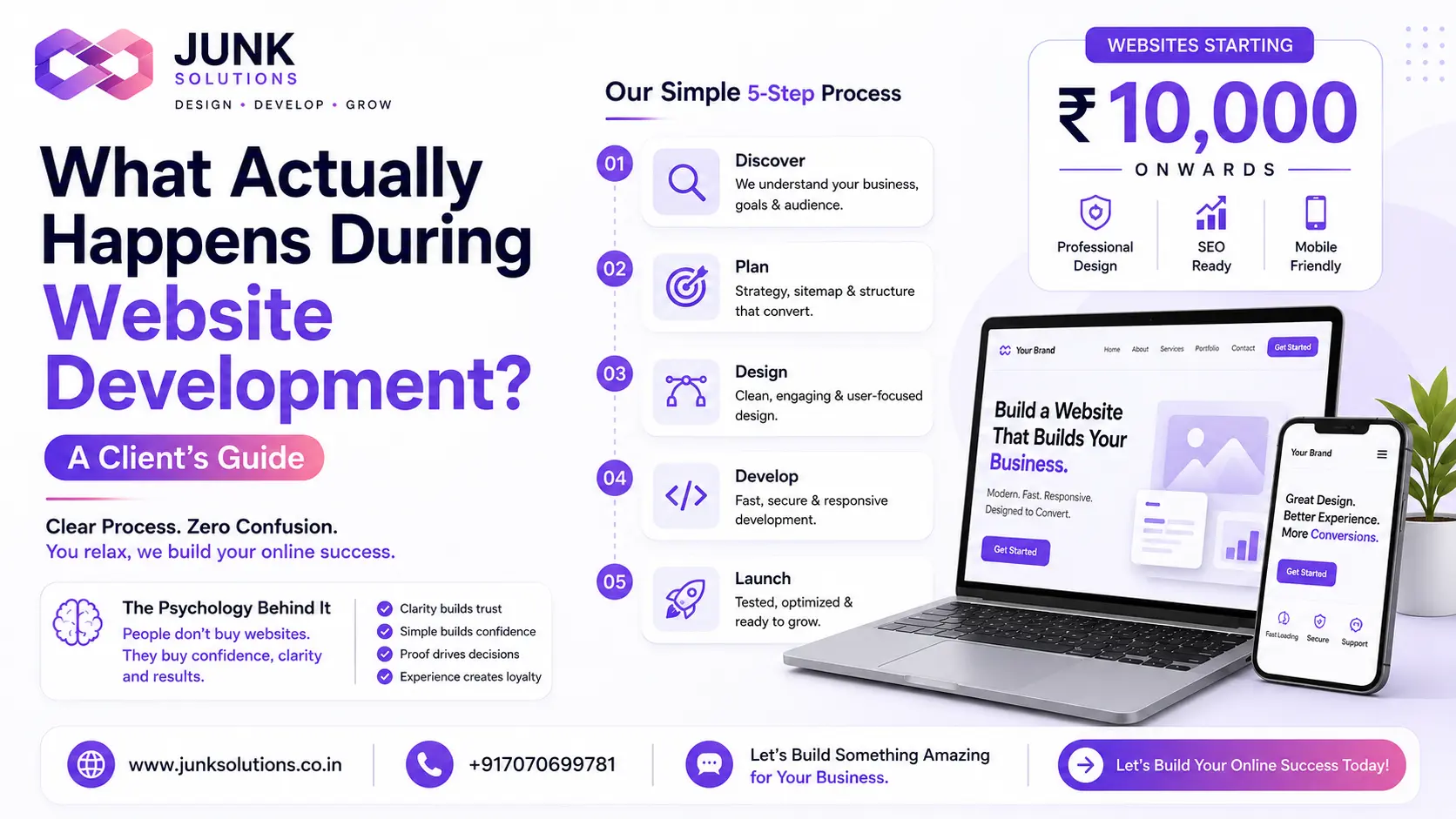
There's a strange gap in how most businesses experience building a website. You sign a contract, agree on a price, and then... mostly wait. Weeks go by. Occasionally someone emails asking for your logo files or a list of services. Then, eventually, a link arrives with something that either looks like what you pictured or doesn't, and either way you're not entirely sure what happened in between.
This guide exists to close that gap. Whether you're about to start a project or you're currently in the middle of one wondering what's supposed to be happening right now, this walks through the actual website development process, phase by phase, in plain language — no jargon you need a developer to translate, no vague reassurance that "it's coming along." Understanding this process also makes you a considerably better client to work with, because you'll know what questions to ask at each stage instead of finding out something went sideways only after it's expensive to fix.
Why Understanding the Process Actually Matters to You
It's tempting to think the process is the developer's problem, not yours — you're paying for a result, not a play-by-play. But website projects go wrong in fairly predictable ways, and almost all of them trace back to a client not knowing what stage they're in or what's expected of them at that stage.
Projects stall because a client didn't realize content was due before design could finish. Budgets balloon because a "quick change" requested during development turns out to unravel decisions made three weeks earlier during planning. Launches get delayed because testing surfaced problems nobody flagged as a risk going in. Nearly all of this is avoidable, and avoiding it starts with knowing what's actually supposed to happen and when.
Phase 1: Discovery and Requirements — Where Good Projects Actually Start
Before any design work or code gets written, a properly run website development process starts with discovery: understanding your business, your goals for the site, your audience, and what "success" actually looks like once the site is live.
This phase should feel like a real conversation, not a form to fill out. A developer or agency worth working with will ask about your customers, not just your services — who are they, what are they trying to accomplish when they land on your site, what typically stops them from converting today if you already have a site. They should ask about competitors, not to copy them, but to understand what you're being compared against. They should ask about content: do you have existing copy and photography, or does that need to be created as part of the project, because this single question quietly determines a huge share of the eventual timeline.
What you should be providing during this phase: clear answers about your business and goals, examples of sites you like (and specifically what you like about them, not just "this one"), any existing brand guidelines or assets, and honest information about your budget and timeline constraints. Vague answers here — "just make it look professional" — push ambiguity downstream into every later phase, where it becomes more expensive to resolve.
This phase typically produces a written scope document: what pages exist, what functionality is included, what's explicitly out of scope, and a realistic timeline. Read this document carefully before approving it. This is the cheapest possible point in the entire website development process to catch a misunderstanding, because nothing has been built yet.
Phase 2: Planning and Information Architecture
Once requirements are settled, the next phase is less visible than design but arguably more important to the site's eventual usability: information architecture. This is where someone maps out how the site is actually structured — what pages exist, how they connect, what the navigation looks like, and what a visitor's actual path through the site should be to accomplish what you want them to accomplish.
This usually shows up as a sitemap and sometimes wireframes — rough, deliberately unstyled sketches of page layouts that show where content blocks go without any visual design applied yet. Wireframes look almost aggressively plain on purpose. Their entire job is to let you and the development team agree on structure and content hierarchy before anyone invests time in visual polish that would need to be redone if the underlying structure changes.
This is a genuinely important moment to engage seriously rather than rubber-stamp. Changing structural decisions later — realizing three weeks into design that you actually need a comparison page you didn't originally scope, or that the navigation needs a completely different hierarchy — is more disruptive and expensive than it would have been to catch here. If a wireframe seems off, or a page seems to be missing something important, this is the phase to say so.
Phase 3: Visual Design — Where the Site Starts Looking Like Something
This is the phase most clients are actually excited about, and reasonably so — it's the first point where a project starts looking like a real website rather than documents and diagrams. A designer takes the approved structure from wireframing and builds out the actual visual language: colors, typography, imagery style, and layout treatment for each page type.
Typically you'll see this as static design mockups — polished images of what key pages will look like — before any of it gets built as an actual functioning website. This sequencing matters: reviewing and revising a static image is dramatically faster and cheaper than reviewing and revising the same change once it's been coded into a working page.
Good feedback at this stage is specific and tied to your actual goals, not just aesthetic preference. "This doesn't feel like it matches how we talk to customers" is useful feedback. "I don't love it" without more detail leaves a designer guessing, and guessing wrong costs another revision round. It's also worth resisting the urge to design by committee — if multiple people at your company are giving feedback, someone should be consolidating that into one clear, sometimes even contradictory-resolved, set of notes rather than the designer trying to reconcile five different opinions independently.
Most website design and development company workflows build in two to three rounds of revision at this stage as standard. If you're on your fourth or fifth round and still unhappy, that's usually a sign the original direction wasn't right, not that one more tweak will fix it — worth having a direct conversation about restarting the concept rather than continuing to iterate on something that isn't working.
Phase 4: Development — Turning Designs Into a Working Site
This is where the bulk of the technical work actually happens, and it's also the phase clients understand least, mostly because it's the least visible. Developers are taking the approved designs and building them into a real, functioning website — writing the code, setting up the content management system, building out any custom functionality, and connecting whatever needs connecting (payment processors, booking systems, CRM integrations, and so on).
Custom website development at this stage means the site is being built specifically around your requirements rather than adapted from a pre-built theme, which is exactly why this phase tends to take real time — every page template, every interactive element, every piece of custom web development functionality is being built and tested individually rather than pulled off a shelf. If your project is using a CMS platform like WordPress with a more template-driven approach, this phase moves faster, but the underlying work — connecting design to function, setting up content structures, building forms and interactive elements — is fundamentally the same category of work either way.
Whether you're working with a web development company building a fully bespoke platform or a smaller team offering web design and development services around a CMS, the phase structure covered in this guide holds either way — what changes is mainly how much of each phase is custom-built versus configured from existing tooling. If you want to build custom website functionality that goes beyond what a template supports — a booking system, a member portal, an unusual product configurator — expect this phase specifically to take longer and involve more back-and-forth testing than a standard content-driven site.
Communication tends to go quieter during this phase, and that's normal, not a red flag by itself — there often isn't much to show visually while backend logic and functionality get built. That said, you should still be getting periodic updates, even brief ones, and you should know roughly where the project stands relative to the agreed timeline. If you haven't heard anything in two or three weeks during active development, it's reasonable to check in.
This is also frequently when clients are asked to provide final content — copy, images, product information, whatever the site actually needs to display. If you haven't provided this yet and development has started, you're likely creating the exact kind of delay that gets blamed on "the developer" later, when the actual bottleneck was content that hadn't arrived. Getting content ready during Phase 1 or 2, rather than waiting until it's requested here, is one of the single highest-leverage things you can do to keep a project on schedule.
SEO Isn't a Separate Phase — It Gets Built In Throughout
A properly run process treats SEO website development as something woven through discovery, planning, and development, not a checklist applied after the site is finished. This distinction matters more than it sounds like it should — website development and SEO handled as two separate purchases, sometimes by two teams who never talk to each other, is one of the more common and avoidable sources of a site that looks great but ranks poorly.
During discovery, this means understanding what your customers actually search for, and structuring the site's pages and navigation around those terms rather than around internal company jargon. During planning, it means clean URL structures and a logical heading hierarchy baked into the wireframes rather than retrofitted later. During development, it means fast-loading code, proper image optimization, mobile responsiveness that's actually tested rather than assumed, and technical basics like an XML sitemap and correctly configured meta tags.
If a website development company you're working with talks about SEO only as an optional add-on service happening after launch, that's worth a direct conversation. The foundational technical elements that support good search visibility are dramatically cheaper to build in from the start than to retrofit into a finished site, and a site built without them in mind often needs meaningful rework later to fix what should have been correct from day one.
Phase 5: Content Integration and Final Assembly
Once the core development work is functionally complete, the next stage is populating the site with actual final content — real copy in place of placeholder text, real images instead of stock photos used during design, and any last functional pieces connected and tested with real data rather than sample data.
This is often when small but important details get handled: metadata for each page, alt text for images (which matters for both accessibility and SEO), 404 error pages, favicon setup, and analytics tracking installed so you can actually measure performance once the site is live. None of these are individually dramatic, but missing several of them is the kind of thing that quietly undermines an otherwise well-built site.
If you're providing content yourself rather than having it written as part of the project, this is your last real opportunity to review it in context — seeing your actual words on the actual page design often surfaces edits you wouldn't have caught reading a document in isolation. Sentences that read fine in a Word document sometimes look awkward or too long once they're sitting inside an actual page layout.
Phase 6: Testing — The Phase That Gets Rushed More Than Any Other
Testing is where a disproportionate number of website problems should get caught, and it's also the phase most likely to get compressed when a project is running behind schedule — which is exactly backwards, since problems caught here are dramatically cheaper to fix than problems discovered after launch.
Proper testing covers several distinct things: functional testing (do all the forms, buttons, and interactive elements actually work as intended), cross-browser testing (does the site work correctly in Chrome, Safari, Firefox, and Edge, since they don't all render identically), device testing (does the site work well not just responsively but genuinely well on actual phones and tablets, not just a resized browser window), and performance testing (does the site load quickly, and does it hold up under real traffic rather than just a single test visit).
As a client, you should be doing your own testing pass too, not just trusting that the development team caught everything. Click through every page. Submit every form with test data. Try the site on your actual phone, not just imagining how it probably looks. Ask specifically what browsers and devices were tested, since "we tested it" without specifics tells you very little about what was actually checked.
This is also a reasonable point to ask about security basics — SSL certificate configuration, whether the CMS and any plugins are up to date, and what the plan is for keeping the site secure after launch, since none of that should be left as an afterthought.
Phase 7: Launch — Less Dramatic Than It Sounds, More Coordinated Than You'd Expect
Launch day itself is usually less eventful than it sounds, precisely because a properly managed process front-loads the risk into testing rather than saving it for launch. That said, there's real coordination happening: DNS settings pointing your domain to the new site, final backups taken of anything being replaced, and a rollback plan in place in case something unexpected surfaces once real traffic hits the live site.
A well-run launch typically happens at a low-traffic time for your business, gets monitored closely for the first few hours for anything that didn't show up in testing, and includes a specific person responsible for watching and responding if something does go wrong. If nobody has discussed what happens if something breaks in the first hour after launch, that's a gap worth closing before launch day, not during it.
It's worth setting expectations honestly here: minor issues after launch are common and not usually a sign of a poorly run project. A broken link, a small formatting inconsistency on an unusual screen size, a form field validation that needs adjusting — these show up even in well-tested projects because real-world traffic and behavior always surfaces things a testing process didn't anticipate. What should concern you is a lack of clear process for reporting and fixing these quickly, not their existence.
Website Development and Marketing Should Connect, Not Operate Separately
A site that's technically well-built can still underperform if it was developed in isolation from how you actually plan to market it. Website development and marketing work best as one connected conversation rather than two unrelated projects that happen to both involve your website.
This shows up in practical ways: landing pages built to match specific campaigns you're planning to run, messaging on the site that's consistent with what's bringing people there in the first place, and analytics set up in a way that actually lets you measure what your marketing spend is producing once traffic starts arriving. A web development and digital marketing services provider handling both under one roof can, in principle, keep these connected by default. If you're working with separate vendors for development and marketing, it's worth deliberately looping them into the same conversations rather than assuming they'll naturally coordinate on their own — in practice, they often don't unless someone actively makes that happen.
This matters more than it might seem during the process itself, because decisions made early in development — page structure, what data gets tracked, how forms are built — directly affect what your marketing team can actually do once the site is live. Retrofitting proper tracking or restructuring pages after launch to support a marketing strategy that wasn't considered during development is real, avoidable extra work.
What "Developing a Web Presence" Actually Means Beyond the Site Itself
It's worth zooming out briefly, because a website itself is only part of what most businesses actually need. Developing a web presence for a business typically also touches things adjacent to the core build: how the site connects to your Google Business Profile and other listings, whether social media links and sharing previews are configured correctly, and how the site fits into a broader digital footprint rather than existing as an isolated asset.
None of this needs to be part of the core development contract necessarily, but it's worth asking who's responsible for it, since it's easy for these pieces to fall into a gap between "that's the developer's job" and "that's the marketing team's job" and end up handled by nobody.
After Launch: The Part Most Guides Skip Entirely
A website isn't actually finished at launch — it's the point where ongoing work shifts from building to maintaining and improving, and this phase gets skipped in most explanations of the process despite being where a meaningful share of a site's long-term value actually gets created or lost.
At minimum, post-launch involves security monitoring and software updates (especially important on CMS platforms like WordPress, where outdated plugins are a common vulnerability), regular backups, and periodic content updates as your business changes. Beyond the basics, website design and optimization work — testing what's actually converting, refining pages based on real visitor behavior rather than assumptions made during design, adjusting based on analytics data that only exists once the site has real traffic — is genuinely ongoing rather than a one-time task. This is usually where standard web development services quietly stop unless a maintenance retainer is part of the original agreement, so it's worth confirming upfront rather than assuming it's included.
Ask about this explicitly before a project starts, not after launch when you suddenly need something fixed and aren't sure who to call. What does post-launch support actually include? Is it included in the original price, or billed separately? What's the response time if something breaks? Getting clear answers here before signing anything avoids an uncomfortable surprise later.
Choosing a Website Development Company With This Process in Mind
Understanding the full website development process gives you a genuinely useful tool for evaluating who to work with in the first place: ask any website development company you're considering to walk you through their actual process, phase by phase, before you sign anything.
A professional website development company should be able to describe this clearly and specifically, roughly matching what's outlined above, even if their terminology differs slightly. Vague answers — "we'll design it, then build it, then it's done" — suggest a less structured process than you want handling your project. Specific answers, with realistic timelines attached to each phase and clear expectations about what's needed from you at each stage, are a strong signal you're working with a team that's done this many times and knows where things typically go wrong.
It's also worth asking directly about the things this guide has flagged as common failure points: how they handle content collection and delays, what their revision process looks like during design, how thoroughly they test before launch, and what post-launch support actually includes. A website development guide like this one is useful preparation, but the real test is whether the team you're hiring can answer these questions specifically, from experience, rather than reciting generic reassurances.
Bringing It Together
The gap between "I hired someone to build a website" and "I understand what's actually happening with my project" is almost entirely a matter of knowing the phases above and what's expected of you at each one. Discovery sets the foundation. Planning establishes structure before anything is styled. Design gives you something concrete to react to before code gets written. Development turns approved plans into a working site, with SEO built in throughout rather than bolted on after. Testing catches problems while they're still cheap to fix. Launch is coordinated, not chaotic. And what happens after launch determines whether the investment keeps paying off or slowly decays from neglect.
None of this requires you to become a developer yourself. It requires knowing enough about the process to ask the right questions at the right moments, provide what's needed from you before it becomes a bottleneck, and recognize the difference between normal project friction and an actual warning sign. A client who understands this process isn't just easier to work with — they consistently end up with a better final site, because informed feedback at the right phase is worth more than frustrated feedback after launch.
FAQs
1. How long does the typical website development process take from start to finish? For a standard business website, four to eight weeks is typical from kickoff to launch. More complex projects, or those with custom functionality and multiple integrations, often take three to six months. Timelines depend heavily on how quickly content and feedback are provided at each phase.
2. What's the biggest thing clients do that delays a website project? Late content delivery is the most common cause. Copy, images, and product information are frequently requested well before a client expects, and delays here push back every subsequent phase, even though the delay often gets attributed to the development team instead.
3. Should I expect to see designs before the site is actually built? Yes. A proper website design and development process includes a design review phase — usually static mockups — before any of that design gets built into a working site. Reviewing and revising a design image is significantly faster and cheaper than revising the same thing after it's been coded.
4. How many rounds of revisions are normal during the design phase? Most website development services include two to three rounds of revision as standard. If you're well beyond that and still not satisfied, it's often more efficient to have a direct conversation about the overall direction rather than continuing incremental tweaks.
5. When should SEO be considered in the website development process? From the very beginning, not as an afterthought. SEO website development that starts during discovery and planning — proper URL structure, heading hierarchy, and page organization built around actual search behavior — is considerably more effective and cheaper than retrofitting SEO onto a finished site.
6. What should I be testing myself before a site launches? Click through every page, submit every form with test data, and check the site on your actual phone rather than just a resized browser window. Ask specifically which browsers and devices the development team tested, since a vague "we tested it" doesn't tell you much.
7. Is it normal for something to break shortly after launch? Minor issues are common even with well-tested projects, since real traffic and behavior surface things a testing process can't fully anticipate. What matters is whether there's a clear, fast process for reporting and fixing these issues, not whether they occur at all.
8. Do website development and marketing need to be handled by the same company? Not necessarily, but they need to be coordinated. Whether through a single web development and digital marketing services provider or two separate teams working closely together, decisions made during development, like tracking setup and page structure, directly affect what a marketing team can do once the site is live.
9. What should be included in post-launch support? At minimum, security monitoring, software updates, regular backups, and a clear process for reporting and fixing bugs. Ask explicitly whether this is included in your original quote or billed separately, and what response time to expect if something breaks.
10. What questions should I ask a website development company before hiring them? Ask them to walk through their actual process phase by phase, how they handle content delays, what their design revision process looks like, how thoroughly they test before launch, and exactly what post-launch support includes. Specific, detailed answers are a much stronger signal than general reassurances.