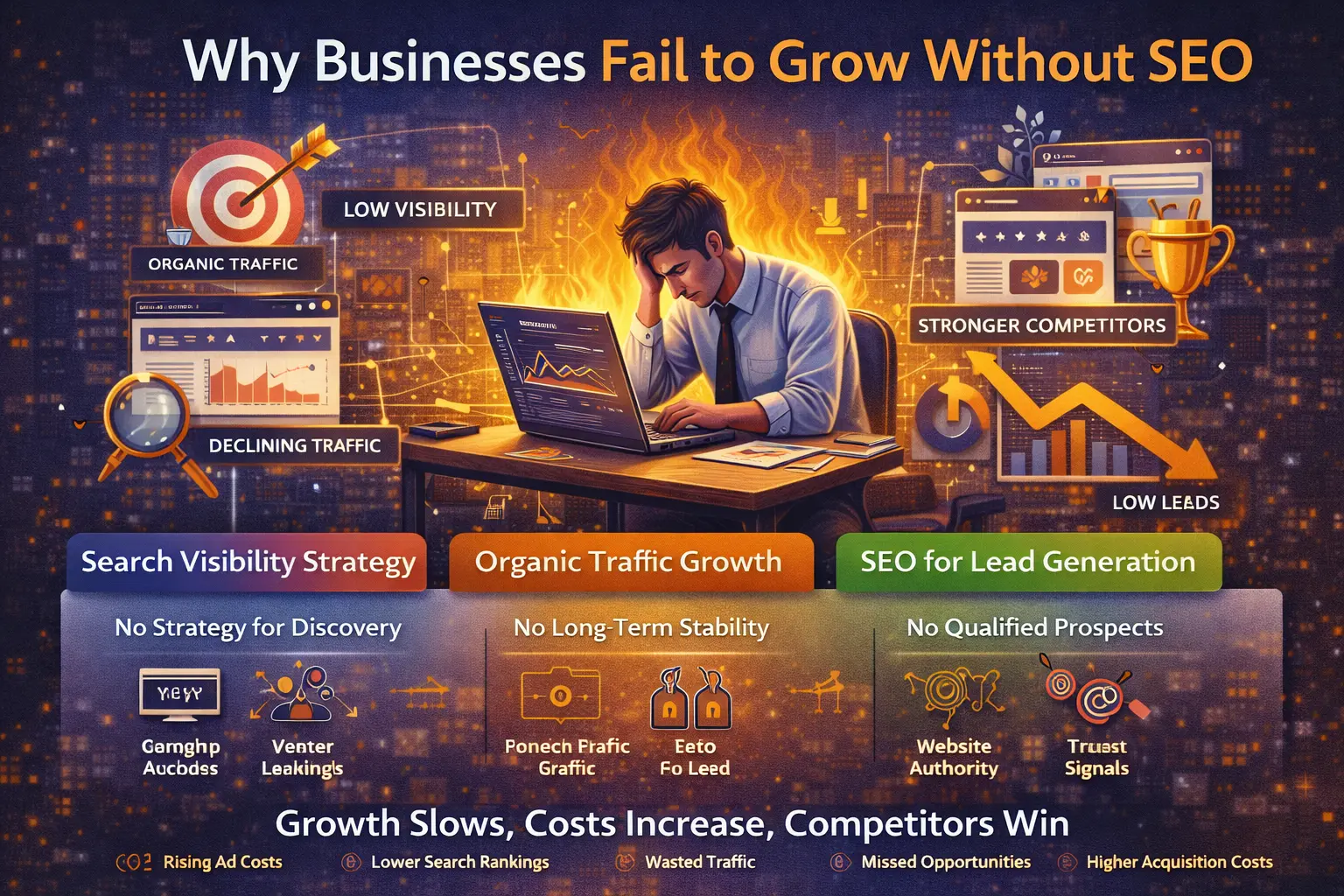
In the digital economy, visibility is power. No matter how innovative your product or how dedicated your team is, if customers cannot find you online, growth becomes unpredictable. This is why business growth without SEO often turns into slow, expensive, and unstable expansion.
Many businesses invest in social media ads, influencer marketing, and short-term campaigns, but overlook the most sustainable digital growth engine—search engine optimization. Understanding the SEO importance for businesses is no longer optional. It is the difference between temporary traction and long-term dominance.
Without SEO, businesses struggle with visibility, authority, and consistent lead generation. Over time, competitors who invest in SEO begin to outperform, out-rank, and outgrow them.
The Hidden Growth Barriers Created by Ignoring SEO
SEO is not just about rankings. It affects traffic, credibility, authority, and customer acquisition. When businesses ignore it, several hidden problems begin to surface.
Search Engine Visibility Strategy Determines Market Reach
A structured search engine visibility strategy ensures your business appears when potential customers actively search for solutions. These are not casual browsers—they are high-intent users ready to evaluate options.
Without this strategy:
-
Your competitors dominate search results.
-
Your website remains invisible.
-
You miss ready-to-convert prospects daily.
Search engines are demand-capture platforms. Ignoring SEO means ignoring existing demand.
Organic Traffic Growth Builds Sustainable Stability
Paid ads generate traffic—but only while the budget runs. In contrast, organic traffic growth compounds over time. When pages rank, they continue attracting visitors without ongoing cost per click.
Businesses without SEO often experience:
-
Rising advertising expenses.
-
Dependency on paid acquisition.
-
Fluctuating traffic.
Organic visibility provides predictable, stable growth.
SEO for Lead Generation Attracts Qualified Buyers
SEO is not about vanity metrics. It’s about attracting the right audience. Effective SEO for lead generation focuses on keywords aligned with purchase intent.
For example:
-
Informational searches build trust.
-
Commercial searches drive evaluation.
-
Transactional searches convert into inquiries.
Without SEO, businesses rely on interruptive marketing rather than intent-based marketing, which reduces efficiency and increases acquisition costs.
Why Rankings Decline Without Continuous SEO Effort
Many business owners believe that once their website is live, growth will naturally follow. Unfortunately, search visibility requires continuous optimization.
Website Ranking Decline Happens Gradually
A website ranking decline often goes unnoticed in the beginning. It may start with:
-
Outdated blog content.
-
Broken internal links.
-
Slow-loading pages.
-
Competitor content improvements.
Over time, small issues accumulate, and rankings drop. Traffic decreases quietly. Lead flow weakens. Recovery becomes harder and more expensive.
Competitive Keyword Strategy Is Critical for Growth
Every industry has high-value search terms that drive revenue. A well-planned competitive keyword strategy identifies:
-
High-intent keywords.
-
Achievable ranking opportunities.
-
Long-tail growth terms.
Without keyword research and strategic targeting, businesses compete blindly. They may rank for irrelevant terms while missing profitable ones.
On Page SEO Fundamentals Strengthen Relevance
Strong on page SEO fundamentals include:
-
Proper heading hierarchy.
-
Clear keyword placement.
-
Optimized meta elements.
-
Structured internal linking.
These fundamentals help search engines understand context and relevance. Ignoring them weakens ranking potential even if the content quality is strong.
Technical SEO Performance Impacts Discoverability
Behind every successful SEO strategy is strong technical SEO performance. Search engines rely on technical signals to crawl and index websites effectively.
Critical elements include:
-
Page speed optimization.
-
Mobile responsiveness.
-
Secure HTTPS implementation.
-
Structured site architecture.
-
XML sitemaps and crawl efficiency.
Technical issues limit discoverability, even if content is valuable.
Backlink Building Strategy Builds Authority and Trust
Search engines use backlinks as trust signals. A consistent backlink building strategy strengthens domain authority and improves ranking power.
Without backlinks:
-
Websites struggle in competitive niches.
-
Content fails to outrank competitors.
-
Authority remains weak.
Backlinks validate credibility.
The Long-Term Strategic Value of SEO
SEO is often misunderstood as a quick tactic. In reality, it is a long-term investment that compounds over time.
Search Engine Marketing Impact Beyond Paid Campaigns
The broader search engine marketing impact includes both paid and organic strategies. However, SEO ensures presence even when ad budgets fluctuate.
Paid campaigns create visibility spikes. SEO builds sustained presence.
Long Term SEO Benefits Compound Over Time
The most powerful aspect of SEO lies in its compounding nature. Long term SEO benefits include:
-
Growing domain authority.
-
Increasing keyword footprint.
-
Higher brand recognition.
-
Lower cost per acquisition.
As optimized pages accumulate, growth accelerates.
Digital Growth Without Paid Ads Creates Resilience
Businesses that rely solely on advertising face vulnerability when:
-
Ad costs rise.
-
Budgets shrink.
-
Platforms change algorithms.
SEO supports digital growth without paid ads, providing stability and resilience during market shifts.
SEO Content Strategy Builds Topical Authority
A structured SEO content strategy focuses on:
-
Answering user intent.
-
Targeting keyword clusters.
-
Building content silos.
-
Supporting the buyer journey.
Over time, this approach supports website authority building, positioning the business as a trusted resource in its industry.
Website Authority Building Enhances Competitive Advantage
Authority is cumulative. Through optimized content and backlinks, SEO strengthens credibility. Website authority building increases trust among both users and search engines.
Authoritative websites rank faster, retain positions longer, and convert better.
Search Visibility Improvement Expands Market Share
Every improvement in ranking contributes to search visibility improvement. Higher rankings result in:
-
Increased traffic.
-
Stronger brand recall.
-
More inbound inquiries.
-
Higher conversion rates.
Search dominance often translates directly into market dominance.
Why Businesses That Ignore SEO Eventually Fall Behind
Markets evolve. Competitors optimize. Customer behavior shifts.
Without SEO:
-
Acquisition costs increase.
-
Rankings decline.
-
Authority weakens.
-
Competitors capture demand.
Growth becomes inconsistent and fragile.
Businesses that prioritize SEO, on the other hand, create scalable systems for attracting, converting, and retaining customers.
Final Thoughts
SEO is not an expense—it is infrastructure. It builds visibility, authority, and consistent demand capture.
Business growth without SEO often results in unstable marketing performance and rising acquisition costs. Understanding the SEO importance for businesses is crucial for sustainable expansion.
When companies invest in structured strategies—covering on page SEO fundamentals, strong technical SEO performance, effective backlink building strategy, and a long-term SEO content strategy—they unlock predictable growth.
In a digital marketplace where visibility determines opportunity, ignoring SEO means surrendering growth to competitors.
FAQs
Q1. Why is SEO critical for business growth?
SEO increases search visibility, drives organic traffic, and generates high-intent leads consistently.
Q2. Can businesses survive without SEO?
Short-term survival is possible, but long-term scalability becomes difficult without organic presence.
Q3. What causes ranking decline?
Outdated content, technical issues, and stronger competitor strategies contribute to ranking drops.
Q4. How long does SEO take to deliver results?
Typically 3–6 months for measurable improvements, depending on competition and optimization efforts.
Q5. Is SEO better than paid advertising?
SEO provides sustainable growth, while paid advertising delivers immediate but temporary visibility. Both work best together.