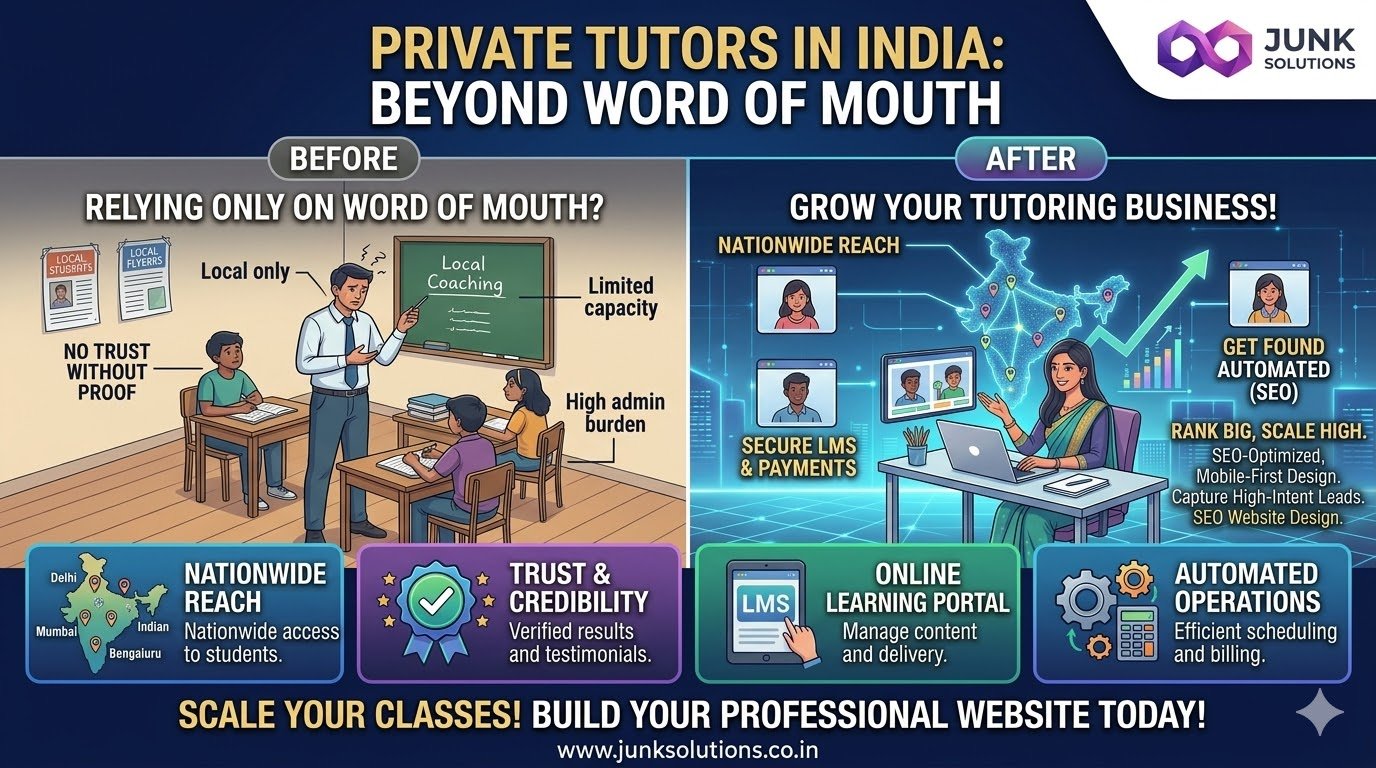
Let’s be completely honest for a minute. If you’ve been teaching privately in India for more than a few years, you probably built your entire student base on one thing: reputation.
You helped a struggling 10th grader finally understand trigonometry. Their parents were thrilled, told three other parents in their housing society, and suddenly, your evening batches were full. It felt organic. It felt earned. For decades, this was the undisputed golden rule of the Indian coaching industry. If you were good, people would talk, and the students would come.
But I want you to think about the last time you needed to hire a professional. Maybe you were looking for a chartered accountant, an interior designer, or a specialized doctor. Did you just ask your neighbor and blindly go with their suggestion? Probably not. You asked for a recommendation, but then you immediately pulled out your phone and Googled them. You looked for a website, you checked their reviews, and you tried to gauge their professionalism before making a call.
Parents and students are doing the exact same thing to you right now.
We are operating in a drastically different environment today. Relying strictly on the local whisper network is no longer a badge of honor; it is a massive bottleneck. The competition isn’t just the other coaching center down the street anymore. It’s the highly polished, venture-funded EdTech giants, and it’s the savvy independent tutors halfway across the country who have figured out how to present themselves online.
If you are an educator who wants to turn a localized hustle into a serious, scalable, and highly profitable enterprise, developing a web presence for a business is step one. You need a dedicated digital headquarters. Let’s dive deep into why the old ways are failing, the hidden dangers of the platforms you might be using right now, and how building your own custom infrastructure is the only way to secure your financial and professional future in 2026.
The Geography Trap: Why Being a "Local Legend" Isn't Enough
Let's look at the basic mathematics of a traditional offline tutoring setup. It’s a very rigid formula. Your maximum income is dictated by the physical size of your room, the number of hours you can physically stay awake and teach, and the number of students who live within a reasonable commuting distance.
You hit an income ceiling very quickly.
Even if you are the most brilliant physics teacher in your city, with a knack for making quantum mechanics easy to understand, you are severely limited. If you want to grow, your options are fairly miserable. You can rent a larger commercial space, which means taking on crippling overhead costs, dealing with landlords, and worrying about electricity bills. Or, you can cram more students into your current space, which dilutes the quality of your teaching and frustrates the students who are paying for your personalized attention.
Word of mouth cannot solve this geography problem. A parent in South Mumbai whose child cracked the NEET exam under your guidance is not going to successfully recommend you to their cousin living in Jaipur. The logistics make it impossible.
This is where the internet completely shatters the old rules.
When you invest in proper educational website development, you obliterate geographical borders. Suddenly, that specialized knowledge you possess is available to anyone, anywhere. A student in a tier-two city who has no access to quality local faculty can now enroll in your premium digital batch. You can teach a live session to fifty students spread across fifteen different states.
More importantly, it allows you to decouple your time from your income. You can record your masterclasses, package them alongside your proprietary study materials, and sell them as complete online courses. This means you can generate revenue while you sleep. But to execute this without your videos being pirated or your website crashing during a launch, you need to work with a specialized education website developer. You need someone who understands how to build a platform that can handle video streaming and secure document delivery, not just someone who makes basic digital brochures.
The Aggregator Illusion: Why You Don't Actually Own Your Business
I talk to tutors all the time who realize they need an online presence, but they take what looks like the easiest path. They sign up for a massive tutoring aggregator app, a freelancer marketplace, or a local business directory.
It makes sense on the surface. Setting up a profile takes ten minutes, it’s usually free to join, and these platforms promise to connect you with thousands of eager students.
But I need you to understand something critical: when you rely on these platforms, you are building your house on rented land.
These aggregator sites are built to protect their own profit margins, not to nurture your career. When you list your services there, you immediately become a commodity. You are placed in a massive, endless directory right next to hundreds of other tutors who claim to teach the exact same subject.
Think about it from the student’s perspective. They are scrolling through a list of twenty chemistry teachers. The profiles all look identical because the platform forces everyone into the same template. So, how does the student choose? They look at the price.
This forces you into a brutal, exhausting race to the bottom. You find yourself constantly dropping your hourly rate just to compete with a college student who is willing to teach for pocket money. You are no longer competing on quality; you are competing on who is willing to work for the least amount of money.
And it gets worse. These platforms take an outrageous cut of your hard-earned income. It is entirely common for these apps to charge commission fees ranging from 20% to 50% per class. You do the lesson planning, you spend the hour teaching, you grade the papers, and the platform takes half your money just for processing the transaction.
Worst of all, you do not own the relationship with the student. The platform intentionally hides the student's personal phone number and email address from you. They do this because they know that if you have a direct line of communication, you will bypass them and stop paying their commissions. If the aggregator decides to change its search algorithm, aggressively hike its fees, or arbitrarily ban your account because of a misunderstanding, your entire student base vanishes in an instant. You have no backup plan.
This is precisely why transitioning to your own platform is an urgent necessity. When you hire a professional website design company to build your own digital hub, 100% of the tuition fee stays in your bank account. You own the customer data. If you want to launch a special 30-day crash course right before the board exams, you can email your entire list of past and present students directly. You dictate the terms, you set the prices based on your actual value, and nobody can take your business away from you.
Trust and Authority in the Digital Age
Indian parents are incredibly protective of their children's academic futures. Education is seen as the ultimate equalizer and the primary path to success. Because of this, when parents are looking for a tutor, they are highly risk-averse. They don't just want a person who knows the subject; they want a proven, undeniable expert who can guarantee results.
When you operate entirely offline or just through a WhatsApp number, you are asking them to take a massive leap of faith. You are asking them to trust a casual recommendation over hard evidence.
When a parent lands on a custom-built, authoritative website, the psychological dynamic shifts completely. A website is your opportunity to stage your expertise. You aren't just verbally claiming to be good; you are providing undeniable proof.
Imagine a parent navigating to your site. The first thing they see is a clean, professional layout. They click on a section dedicated entirely to verified student testimonials. They see scanned copies of actual board exam mark sheets (shared with permission) proving that your students consistently hit the 95th percentile. They read a blog post you wrote breaking down the most common mistakes students make in calculus. They watch a three-minute embedded video of you explaining a complex concept with absolute clarity.
In the span of five minutes, you have completely eliminated their anxiety. They no longer view you as a neighborhood freelancer; they view you as a premium educational institution.
However, the visual presentation must match the level of your expertise. If your website looks like it was thrown together as a weekend project in 2012, with blurry photos, misaligned text, and confusing menus, parents will subconsciously assume your teaching methods are just as chaotic and outdated. This is why engaging with a team that provides expert small business website design and development is so crucial. They understand how to use modern design principles, readable typography, and professional branding to make your site exude authority. The perceived value of your digital presence directly dictates the actual monetary value you can charge for your classes.
The Specialized Needs of Higher Education
This concept of authority becomes even more critical if you are tutoring at an advanced level. While a primary school tutor might get away with a simpler setup, the stakes are entirely different if you are coaching college students for the GATE exam, preparing graduates for the CAT, or teaching highly specialized coding languages to working professionals.
These older students are not relying on their parents to find them a tutor. They are doing the research themselves, and they are ruthless in their evaluation. They demand a very high level of professionalism and technical competence. A basic, generic website template will not convince a 22-year-old engineering graduate to pay you thousands of rupees for advanced coaching.
This specific market requires higher education website development. The platform needs to look corporate, sleek, and deeply authoritative. It needs to handle complex course structures, perhaps offering tiered membership levels or installment payment plans for expensive courses. It might require integration with professional certification boards or the ability to host secure, large-scale live webinars. By upgrading your digital infrastructure to handle these advanced, professional requirements, you position yourself to capture the most lucrative, high-paying segment of the Indian education market.
The Administrative Nightmare: Why You Need an LMS
Let’s step away from marketing for a second and talk about the reality of your day-to-day life as a busy private tutor. Think about how much time you spend doing things that have absolutely nothing to do with teaching.
How many hours do you waste chasing parents for late fee payments? How much time do you spend manually generating and messaging Zoom or Google Meet links for every single class? How often do you find yourself digging through your computer folders to find that one specific worksheet for a student who missed Tuesday's session? How many evenings are lost to grading weekly multiple-choice quizzes by hand?
This administrative burden is the silent killer of tutoring businesses. It is the main reason independent educators burn out. It places a hard limit on how many students you can handle because you simply run out of hours in the week to manage the paperwork and the communication.
This is where proper online learning website development completely changes your life. It involves integrating a powerful Learning Management System (LMS) directly into your website. An LMS essentially turns your website into a fully automated digital school.
Here is what that looks like in practice: A student visits your website, reads about your "Class 12 Physics Crash Course," and clicks the enroll button. They are instantly taken to a secure checkout page where they pay using their preferred method—UPI, credit card, or net banking.
The moment that payment is successful, the magic happens. You don't do anything. The system automatically creates an account for the student. It emails them a branded receipt. It grants them access to a private, secure student dashboard.
Inside that dashboard, the student finds everything they need without ever having to text you. The links to your upcoming live classes are automatically generated and posted there. Your pre-recorded video lectures are securely hosted (with anti-piracy measures in place) so they can watch them on demand. Their homework assignments are listed with clear due dates. You can even set up online quizzes that grade themselves the absolute second the student hits submit, immediately showing them their score and the correct answers.
You wake up, you teach your class with passion and energy, and the website handles literally everything else. This level of operational efficiency allows you to easily manage 500 students with the exact same amount of administrative effort it used to take to manage 50.
The Mobile Reality: Meeting Students Where They Are
We have to look closely at how Indian students actually consume information and interact with the internet today. The days of a student sitting down at a large, dedicated desktop computer in a quiet study room are largely over.
Especially in tier-two and tier-three cities, where mobile data is incredibly cheap but broadband connections might be unreliable, the smartphone is the primary educational tool. Students are watching your lecture videos on their phones while commuting. They are downloading your PDF notes on their phones. They are taking your practice tests on their phones. The learning experience is entirely fragmented and overwhelmingly mobile-first.
If your website is only designed to look good on a laptop, you are going to lose a massive amount of business. Imagine a student trying to open your site on their mobile device. The text is microscopic. The navigation menus are impossible to click with a thumb. They have to scroll horizontally just to read a single sentence. What do they do? They leave immediately out of sheer frustration.
This is why investing in responsive website design services is not just a "nice-to-have" feature; it is a critical requirement for survival. Responsive design is a sophisticated coding technique that ensures your website automatically detects the screen size of the device being used and instantly adjusts the layout to fit perfectly. The images scale appropriately, the menus transform into easy-to-use tap targets, and the text remains perfectly readable without any zooming required.
Furthermore, you have to consider how search engines behave. Google knows that the vast majority of its users are on mobile devices. Because of this, they have implemented a policy called "mobile-first indexing." This means Google only evaluates the mobile version of your website when deciding where to rank you in the search results. If you do not have a mobile friendly website design, Google will heavily penalize your site. It doesn't matter how great your content is; if it doesn't work on a phone, Google will ensure that no one ever finds you when they search for a tutor. You must provide a flawless mobile experience to keep both your students and the search engines happy.
The Art of Being Found: Mastering Search Intent
So, you have partnered with a great developer, and you now have a secure, fast, beautifully designed digital classroom that works perfectly on a mobile phone. But here is the hard truth: building it does not mean they will come.
You can build a digital palace, but if it is hidden in the middle of a desert, it won't generate a single rupee. You need traffic. And not just any traffic—you need targeted, high-intent traffic.
Many tutors try to solve this by throwing money at Facebook or Instagram ads. While social media marketing has its place, it’s a constant financial drain. The moment you stop paying for the ads, the inquiries stop completely. Moreover, social media traffic is often low-intent. When someone is scrolling through Instagram, they are looking to be entertained. If they see an ad for your math classes, they might find it mildly interesting, but they probably aren't in the mindset to pull out their credit card right then and there.
Search Engine Optimization (SEO) is a completely different game. It is about capturing high-intent traffic.
When a parent types "best online math tutor for CBSE class 12 near me" into Google, they are actively looking to spend money. They have a specific, urgent problem (their child is struggling in math), and they are actively searching for the solution (you). If your website ranks at the top of those search results, you are capturing the most valuable leads possible.
But getting to the top of Google isn't an accident. It requires a dedicated, scientific strategy known as seo website design. This means that your website is not just built to look aesthetically pleasing to humans, but it is engineered from the ground up to be perfectly understood by Google's complex search algorithms.
This process starts long before the design phase, with deep keyword research. A specialized agency will analyze exactly what terms Indian students and parents are typing into the search bar. Then, they build the entire architecture of your site around those terms. They ensure your page titles, your URLs, and your header tags are perfectly optimized.
But true SEO goes much deeper than just sprinkling keywords into your text. Google ranks websites based on their technical health. If your site code is bloated, causing the pages to load slowly, Google will drop your ranking. If your site lacks proper security protocols, Google will drop your ranking.
This is why you need a team that provides expert website design and seo services. They ensure that the backend of your website is lightning fast and highly secure. They also implement something called schema markup—specialized code that helps Google display your course offerings, your star ratings, and your reviews directly in the search results page, making your listing incredibly clickable.
When you seamlessly combine website design and seo, you create a platform that naturally and consistently rises to the top of search engines. Once you achieve and maintain those top rankings, you receive a continuous, free stream of highly qualified leads. You are literally attracting new, paying students while you sleep.
Choosing the Right Partner for Your Digital Evolution
We have established a lot of technical requirements. You need a highly secure, incredibly fast, mobile-responsive, SEO-optimized website with a fully integrated Learning Management System that can handle Indian payment gateways without a hiccup.
Unless you possess a degree in computer science and have years of experience in digital marketing, you cannot build this yourself. Trying to save a few rupees by using a cheap template on a generic platform will result in a fragile site that crashes when you get too much traffic, gets hacked because it lacks basic security, and never ranks on Google because the code is a mess.
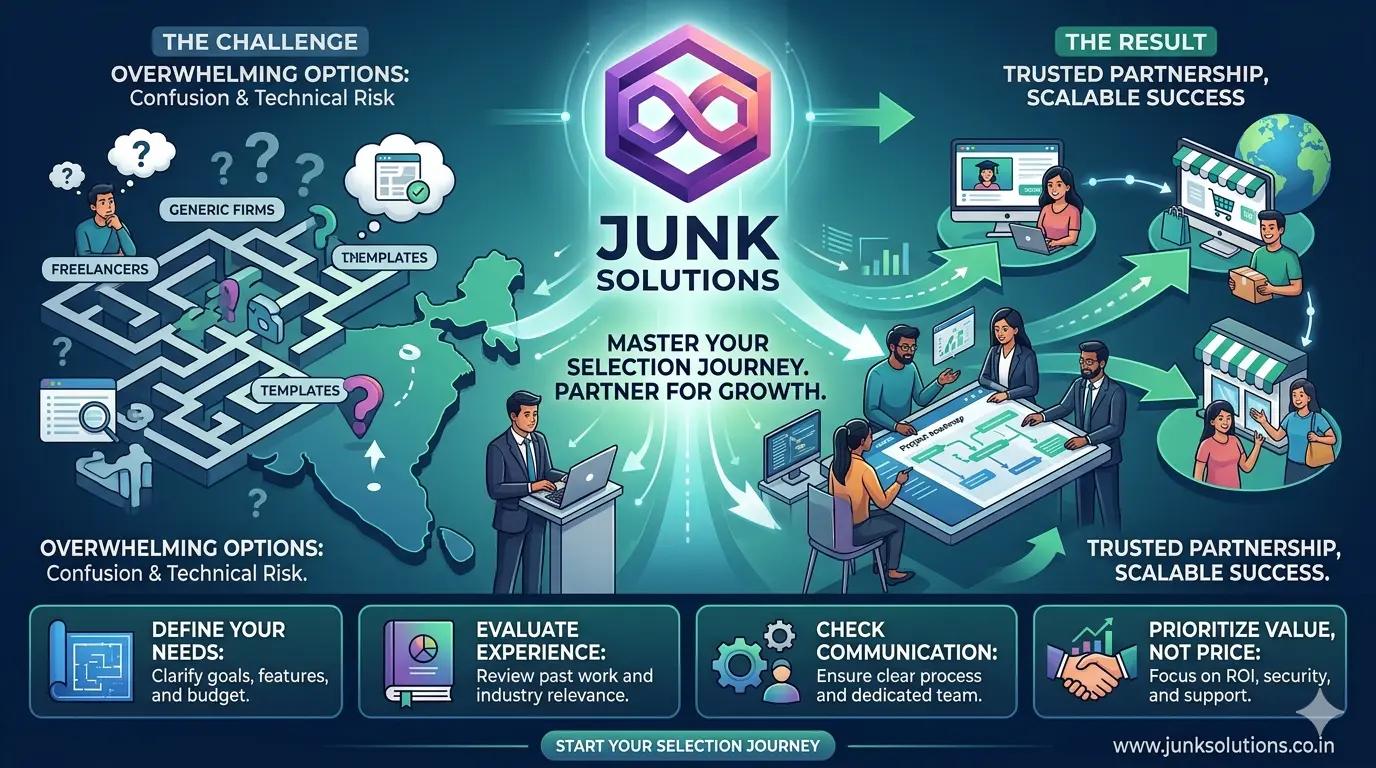
You need to hire professionals. But you shouldn't just hire any local web designer who usually builds single-page menus for restaurants. You need an agency that intimately understands the specific, complex needs of the education sector.
You should specifically look for a professional website development company that also operates as a full-service website development and digital marketing company.
Why is it so important to have both under one roof? Because design, development, and marketing cannot happen in isolation. If you hire a freelance coder to build the site, and then six months later hire an SEO specialist to try and rank it, they will constantly clash. The SEO expert will say the coder built the site wrong and didn't implement the right heading structures, and the coder will say the SEO expert doesn't understand the limitations of the platform. It becomes a frustrating, expensive mess.
When you partner with a unified agency that provides comprehensive website design and development services alongside expert seo web design services, everything works in perfect harmony from day one. The development team builds fast, lightweight landing pages that the SEO team has already researched and approved. The content writers create blog posts that fit perfectly into the site's technical architecture.
For an independent tutor looking to dominate their niche and scale their income, this is the ultimate growth strategy. It gives you an entire team of technology and marketing experts dedicated to scaling your business. It allows you to step away from the administrative chaos and the stress of hunting for students, so you can focus entirely on what actually matters: delivering exceptional education and changing your students' lives.
Stop relying on the unpredictable, slow whispers of local word of mouth. Stop giving away half your income to aggregator apps that treat you like a disposable commodity. Take control of your career, build your own digital infrastructure, and establish yourself as the national authority you deserve to be.
Frequently Asked Questions (FAQs)
1. Is word of mouth really useless for tutors in India now? No, it's not useless, but it's severely limited. Word of mouth restricts you geographically and grows very slowly. A professional website acts as a digital megaphone for your word of mouth, allowing thousands of people nationwide to see your verified results and reviews instantly.
2. What makes educational website development different from building a standard business website? A standard business site is often just an informational brochure. An educational website requires complex backend engineering, including a Learning Management System (LMS) for course delivery, secure video hosting to prevent piracy, student dashboards, and automated grading systems.
3. Why should I invest in a professional website development company instead of using a free DIY site builder? DIY builders generally produce bloated code, leading to slow loading times and poor Google rankings. They also lack the robust security needed for processing payments and protecting your course materials. A professional company builds a secure, fast, and scalable platform tailored to your specific teaching needs.
4. How does a mobile friendly website design actually impact my tutoring business? The vast majority of Indian students use their smartphones for online learning and research. If your website isn't perfectly optimized for mobile, students will get frustrated and leave. Additionally, Google penalizes sites that aren't mobile-friendly, drastically reducing your organic visibility.
5. What is the real benefit of combining website design and seo services? A beautiful website is useless if no one can find it. Combining design and SEO from the start ensures that the website is built with clean code and an optimized structure, so it ranks highly when students search for tutors in your specific subject area, driving free, high-intent traffic.
6. Can developing a web presence for a business really help me get students outside my own city? Absolutely. With an optimized website and an integrated payment gateway, a tutor based in Delhi can easily enroll, charge, and teach a student based in Chennai. The internet completely removes geographical barriers to your income.
7. Why is online learning website development crucial for protecting my study materials? If you just email PDFs, they will be easily forwarded and shared for free, costing you revenue. A proper online learning platform secures your intellectual property. Students must log in to view your materials, and developers can implement measures that make downloading and pirating your videos incredibly difficult.
8. How does a website development company for small business help with my daily admin tasks? They integrate automated systems into your site. Instead of you manually tracking fees and sending class links on WhatsApp, the website handles automatic payment processing, invoice generation, and instantly provides students with their dashboard access upon successful payment.
9. What does an education website developer do to ensure my site ranks well on Google? They focus heavily on technical SEO. They ensure the site loads in under three seconds, implement proper URL structures, compress images, and use specific educational schema markup so Google clearly understands your site offers tutoring services and courses.
10. Why should I hire a website development and digital marketing company instead of two separate agencies? Hiring one unified company ensures that your website is built specifically to support your marketing goals. The developers and the SEO experts work together, ensuring the site is fast enough to rank well and designed perfectly to convert the traffic the marketing team brings in, avoiding conflicting strategies.