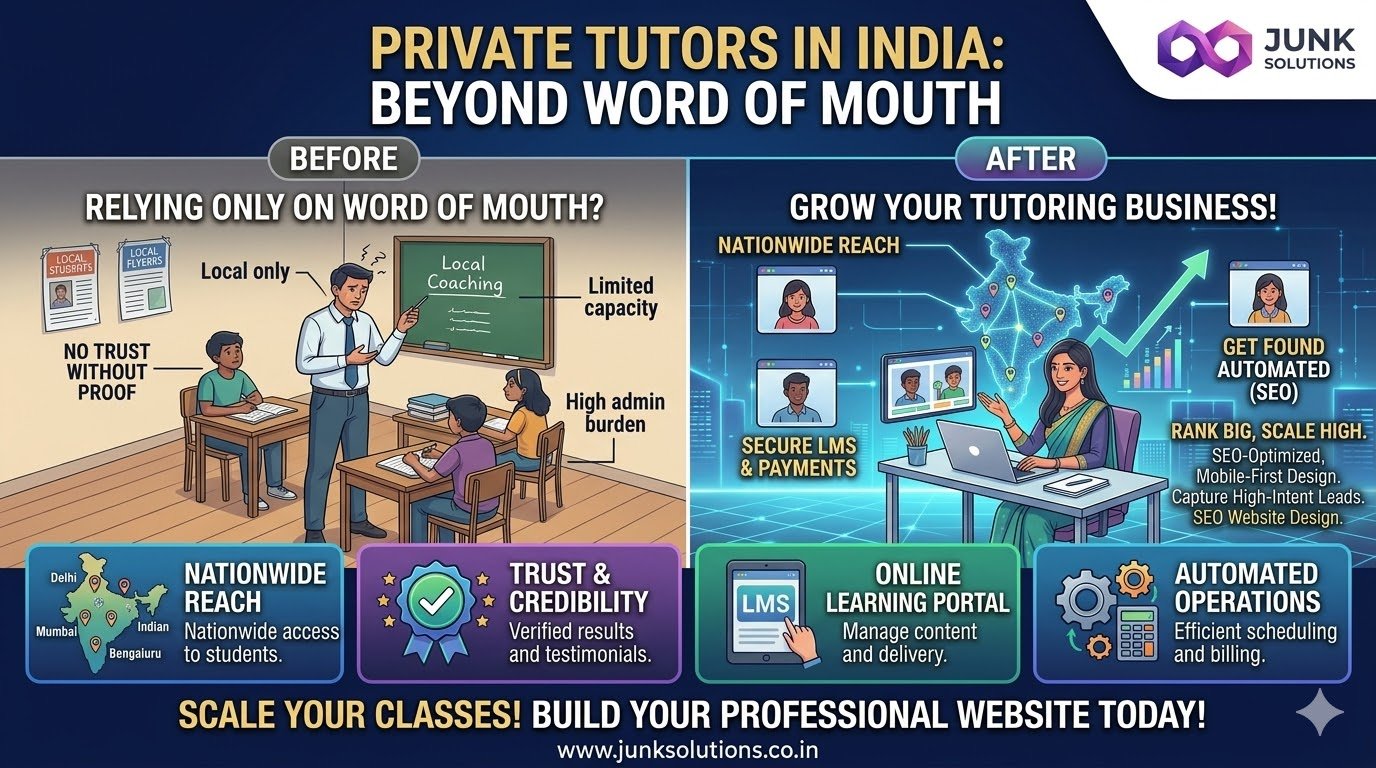
Let's be completely honest about the state of personal tutoring in India right now. A few years ago, if you were a great physics or chemistry teacher in places like Mukherjee Nagar, Kota, or even a local neighborhood in New Delhi, your reputation spread through word of mouth. Parents talked, students recommended you to their juniors, and your batches filled up. You might have put up a few flex banners outside your coaching center or distributed pamphlets in local newspapers, and that was enough.
But things have changed drastically. The Indian education sector has gone completely digital, and the competition has exploded. Today, a student sitting in Patna who is struggling with organic chemistry or advanced physics isn't just looking for the best teacher in their colony; they are looking for the best teacher in the country. They open Google or YouTube and search for solutions. If you aren't showing up when they make that search, you are losing out to someone who is—even if you are the better teacher.
For independent educators, developing a web presence for a business is no longer a fancy add-on; it is the absolute backbone of your survival and growth. Relying on WhatsApp groups or third-party tutoring aggregator platforms means you are renting space on someone else's land. They control the algorithms, they take massive cuts of your fees, and they own the student data. To build a brand that lasts, you need your own digital real estate. You need a platform that works 24/7 to bring you leads, process payments, and deliver your lectures. This level of independence requires partnering with a professional website development company that actually understands the Indian EdTech landscape. Let's break down exactly why you need a custom-built, heavily optimized website to scale your tutoring business in India.
1. The Death of the Local Notice Board: India's Digital Education Shift
The way Indian parents and students make decisions about education has fundamentally shifted. They do their research online long before they ever make a phone call to a tutor. They want to see your qualifications, watch demo videos of your teaching style, and read testimonials. If your entire online presence is just an old Facebook page or a free listing on a local directory, you instantly lose credibility in their eyes.
When you hire a professional website design company, you are telling your prospective students that you treat your teaching as a serious, professional institution. A well-structured website acts as your receptionist, your sales team, and your administrative block, working around the clock to convert casual visitors into enrolled, paying students.
The Hyper-Competitive NEET and JEE Market
Nowhere is this shift more obvious than in the preparation for competitive exams like NEET and JEE. The stakes are incredibly high, and parents are willing to invest heavily in the right guidance. But the market is completely flooded. Every day, new tutors are popping up offering physics, chemistry, and math coaching. How do you stand out?
You stand out by showing, not just telling. A customized website allows you to create dedicated landing pages for your specific courses. If you are a master at explaining thermodynamics or solving complex integration problems, your website becomes the stage to showcase that expertise. You can host free mock tests, upload previous years' question paper solutions, and write detailed study guides. When a highly stressed JEE aspirant searches for a specific physics concept and lands on your beautifully designed, helpful website, you instantly win their trust. This isn't just about looking good; it's about strategic educational website development that positions you as an undeniable authority in your specific subject.
Breaking Geographic Boundaries
Think about the physical limitations of a traditional coaching center. You can only teach the students who can physically travel to your location. Your revenue is strictly capped by the number of chairs in your room and the hours in your day.
A professional website shatters these boundaries. With the right technical setup, you can teach a student in Mumbai, a student in Dubai, and a student in your own neighborhood simultaneously. You can sell pre-recorded video courses that generate passive income while you sleep. But you can't manage a nationwide or global student base through WhatsApp links. You need a secure, centralized hub where students log in, pay via UPI or international credit cards, and access their specific batches. This kind of heavy-lifting requires specialized online learning website development. It requires databases that don't crash when fifty students log in to take a Sunday mock test, and video hosting that streams smoothly even on fluctuating internet connections in tier-2 cities.
Why Aggregator Platforms Are Failing Indian Tutors
It's tempting to just sign up for massive online tutoring platforms. They promise you instant students. But the reality is grim for independent teachers. On those platforms, you are just a face in a crowded catalog. The platform forces you into a price war with thousands of other tutors, pushing your hourly rates lower and lower. Worse, if a student finds you there, they belong to the platform, not to you.
Building your own platform is how you escape this trap. When you invest in small business website design and development, you own 100% of your business. You set your own fees without a middleman taking a 30% cut. You collect the email addresses and phone numbers of your leads, allowing you to market your crash courses or revision batches directly to them later. It is a long-term investment in your own brand equity, ensuring that the hard work you put into teaching builds a business asset that you actually own.
2. Core Elements of a High-Converting Teaching Platform
Having a website is one thing; having a website that actually convinces a parent to pay a premium fee is entirely another. A lot of tutors make the mistake of buying a cheap, readymade template, slapping their photo on it, and wondering why nobody is signing up. The truth is, modern internet users are incredibly impatient. If your site looks outdated, loads slowly, or is confusing to navigate, they will hit the back button in less than three seconds.
To build a platform that converts, you need an education website developer who understands the psychology of a student. The user journey must be completely frictionless, from the moment they read your blog post to the moment they click the "Enroll Now" button.
Seamless Video and LMS Integration for Tier-2 and Tier-3 Cities
If you are targeting students across India, you have to account for the reality of Indian internet infrastructure. While 5G is spreading, many students in tier-2 and tier-3 towns still rely on patchy mobile data. If your website is heavy and your videos constantly buffer, the student will simply leave.
This is where expert website design and development services become crucial. Your development team needs to build a lightweight Learning Management System (LMS) that compresses data efficiently. They need to integrate secure video hosting solutions that prevent piracy (so students can't just download your paid courses and share them on Telegram) while still ensuring fast playback. The LMS should include dedicated student dashboards where they can track their syllabus progress, submit assignments, and see their test scores. When parents log in and see this level of professional organization, they feel confident that their money is well spent.
The Critical Importance of a Mobile-First Experience
Look around you. How do Indian students consume content? They are glued to their smartphones. They watch lectures on phones, read PDFs on phones, and take quizzes on phones. If your website is designed only to look good on a laptop, you are ignoring 80% of your potential audience.
You cannot compromise on responsive website design services. A responsive site automatically reshapes itself perfectly to fit any screen, whether it's a cheap Android phone or a high-end iPad. Buttons need to be large enough to tap with a thumb. Text needs to be readable without zooming in. Navigation menus need to slide out smoothly. Beyond just user experience, Google actively punishes websites that are not mobile-optimized. If you lack a mobile friendly website design, Google will push your site so far down the search results that no student will ever find you.
Structuring Your Curriculum for Maximum Engagement
How you present your syllabus on your website is just as important as the syllabus itself. You can't just throw a giant wall of text onto a webpage. It needs to be broken down into digestible, visually appealing modules.
A skilled developer will use dynamic website development techniques to create interactive course catalogs. Students should be able to filter your courses by subject, exam type (e.g., JEE Mains vs. Advanced), and difficulty level. They should see progress bars indicating how much of a chapter they've completed. You can integrate gamification elements—badges or points for completing quizzes—to keep students motivated. These aren't just flashy features; they are proven retention tools. When a student enjoys using your website, they study longer, their marks improve, and they bring you more referrals.
3. Dominating Local and National Search Results
Let's talk about the most important piece of the puzzle: getting found. You can have the most beautiful, technologically advanced website in the world, but if it doesn't show up on the first page of Google when a student types "best chemistry tutor near me" or "online physics coaching for NEET," your website is virtually invisible.
This is where Search Engine Optimization (SEO) comes into play. SEO isn't magic; it's a highly technical process of structuring your website so that Google understands exactly what you teach and who you teach it to. You cannot treat SEO as an afterthought. It must be baked into the very code of your site through seo website design.
Turning Search Queries into Enrolled Students
When a parent is frantically searching for a tutor a month before the board exams, they have what we call "high commercial intent." They are ready to spend money; they just need to find the right person. Capturing this traffic requires a deep understanding of website design and seo.
Your web developer needs to conduct extensive keyword research to find out exactly what phrases Indian students are typing into Google. Then, they must optimize your page titles, meta descriptions, and URL structures around those phrases. Furthermore, they need to ensure your site's technical health is perfect. Google ranks fast-loading, secure (HTTPS) websites higher than slow, insecure ones. By utilizing professional seo web design services, your site is built from the ground up to please both the human reader and the search engine crawler. This means integrating schema markup for your courses, ensuring your images are optimized, and building a clean, logical internal linking structure.
When you seamlessly combine website design and seo services, the results compound over time. Unlike paid Facebook or Google ads, which stop generating leads the minute you stop paying for them, a well-optimized website generates organic traffic month after month, year after year, drastically reducing your cost of acquiring a new student.
Choosing the Right Development Partner for Your Growth
So, how do you actually get this done? As a teacher, your focus should be on teaching, creating great notes, and interacting with your students. You shouldn't be wasting your weekends trying to figure out how to fix a broken WordPress plugin or why your payment gateway isn't working.
You need to hire a specialized website development company for small business. But don't just hire the cheapest freelancer you can find. Look for an agency that actually understands the education sector. Ask them if they have experience building LMS platforms. Ask them how they handle video security. Ask them to explain their approach to on-page SEO.
An ideal partner won't just build a website and walk away. They will act as your technical consultants. They will help you map out your digital strategy, advise you on the best payment gateways for Indian transactions (like Razorpay or standard UPI integrations), and ensure your site is completely scalable. Your website should be able to handle 50 students today and 5,000 students two years from now without missing a beat. By investing in the right team to handle your digital infrastructure, you free yourself up to do what you do best: transform students' lives through education. In 2026, a world-class teacher deserves a world-class platform. Make sure you build yours.
Frequently Asked Questions (FAQs)
1. Why can't I just use a free aggregator platform for my tutoring business in India? Aggregator platforms take large commissions from your fees, force you into price wars with thousands of other tutors, and keep control of your student data. Developing your own web presence gives you total control over your brand, pricing, and student relationships.
2. What exactly does an education website developer do differently than a normal designer? An education developer specializes in building learning environments. They integrate Learning Management Systems (LMS), secure video hosting to prevent content piracy, student progress dashboards, and complex payment gateways suited for courses.
3. Why is a mobile friendly website design so critical for Indian students? The vast majority of Indian students, especially in tier-2 and tier-3 cities, access the internet and their study materials primarily through smartphones. If your site isn't mobile-friendly, it will be unreadable to them, and Google will heavily penalize your search rankings.
4. How do website design and seo services work together to get me more students? Design ensures the website is structured logically and looks trustworthy, while SEO (Search Engine Optimization) ensures the site ranks high on Google when students search for terms like "best online physics tutor." They work together to attract traffic and convert it into enrollments.
5. I'm just a single tutor; do I really need a professional website development company? Yes. Even as a single tutor, you are running a business. A professional company ensures your site is secure, fast, and scalable. A cheap, poorly built site can crash during peak exam seasons, severely damaging your reputation.
6. What is dynamic website development, and why do I need it for coaching? Unlike a static brochure website, dynamic development allows your site to interact with users. This is essential for features like student login portals, live mock tests, automated grading, and personalized course recommendations based on the student's level.
7. Can an SEO website design help me reach students outside my home city? Absolutely. By optimizing your website for national or specific regional search terms (e.g., "JEE chemistry coaching online"), you break geographic boundaries and can enroll students from all over India, not just your local neighborhood.
8. What features are essential for a small business website design and development project in education? Essential features include UPI and card payment gateway integration, a secure LMS, fast-loading responsive pages, SEO-optimized blog architecture, and clear calls-to-action for booking demo classes.
9. Will an educational website development project be too expensive for a local teacher? It is an investment, not a sunk cost. By partnering with a website development company for small business, you can get scalable solutions tailored to your budget that will eventually pay for themselves many times over through increased, commission-free student enrollments.
10. How long does it take for seo web design services to show results in Google rankings? While a new, fast-loading site provides immediate benefits for user experience, organic SEO rankings usually take 3 to 6 months of consistent effort to show significant increases in traffic, as Google needs time to crawl and trust your new content.